
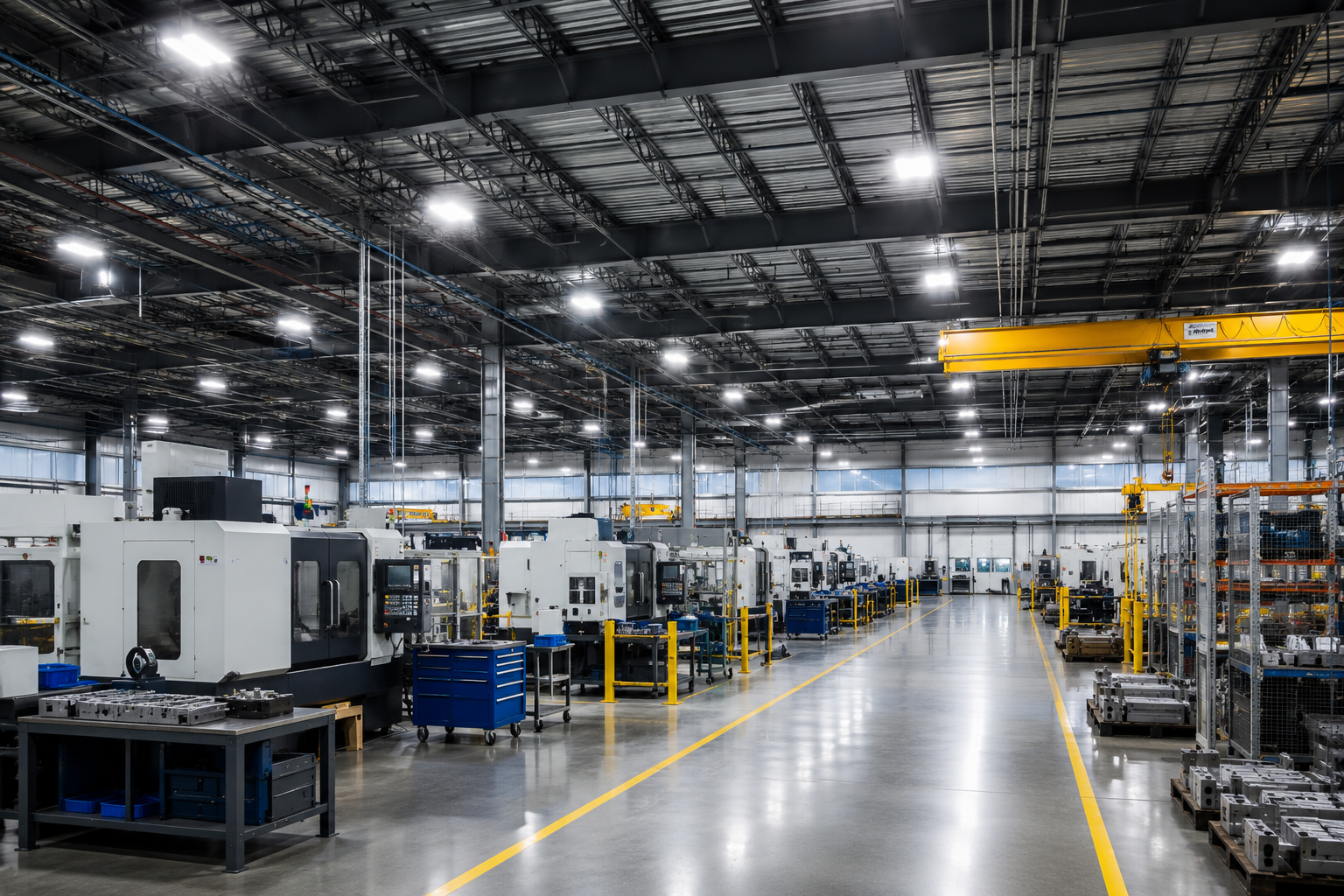
Manufacturing Lighting Engineered Around Your Operation
Manufacturing facilities place unique demands on their lighting systems. Production areas, assembly lines, machining operations, inspection stations, material-handling zones and warehouse areas may all operate within the same facility while requiring very different lighting conditions. LEDTOMORROW helps manufacturers develop commercial and industrial LED lighting strategies around the actual work being performed, with an emphasis on visibility, consistency, efficiency and long-term performance.
Whether you are modernizing an existing plant, replacing aging HID or fluorescent lighting, improving illumination in critical production areas or evaluating lighting controls and photometric design, LEDTOMORROW can help develop a solution around your facility and operational requirements.
A Smarter Approach to Manufacturing Facility Lighting
Manufacturing lighting cannot be approached as a one-size-fits-all application. The illumination required around precision equipment may be very different from what is appropriate for material storage, general production, loading areas, assembly operations or circulation spaces.
LEDTOMORROW evaluates lighting from the perspective of the entire facility. We consider how employees use the space, where detailed tasks are performed, how machinery and equipment affect light distribution, and where existing conditions may create shadows, glare, inconsistent illumination or unnecessary energy use.
The objective is not simply to make a manufacturing plant brighter. The objective is to develop a lighting environment that supports the work being performed while improving efficiency and helping reduce the long-term costs associated with operating and maintaining the lighting system.
What We Consider When Planning Manufacturing Lighting
Manufacturing environments can contain dramatically different spaces under one roof. A successful lighting strategy accounts for both the physical facility and the tasks being performed within it.
Production & Assembly Areas
Production lines and assembly areas require dependable illumination that helps employees clearly see components, equipment and work surfaces. Fixture placement and distribution should support the workflow without creating distracting shadows or excessive glare.
Precision & Inspection Tasks
Quality-control stations, inspection areas and detailed manufacturing processes may require higher or more carefully controlled illumination. Lighting design should account for the visual demands of the task rather than relying solely on general ambient lighting.
Machinery & Equipment Layout
Large equipment, production cells and machinery can obstruct light and create shadows. Understanding equipment placement allows the lighting strategy to be developed around the actual production environment.
Ceiling Height & Facility Configuration
Mounting height, structural obstructions, cranes, utilities and ceiling configuration all influence fixture placement and light distribution. These conditions should be considered before a retrofit or new lighting layout is finalized.
Operating Environment
Dust, moisture, elevated temperatures, washdown conditions and other environmental factors can affect lighting requirements. Industrial lighting strategies should account for the conditions present within the facility.
Operating Hours & Occupancy
Multi-shift and continuous manufacturing operations can place significant demands on lighting systems. Understanding occupancy patterns and operating schedules can also reveal opportunities for controls and additional energy savings.
Photometric Planning for Manufacturing Facilities
Photometric analysis provides a way to evaluate a proposed lighting system before installation. For manufacturing environments, this can be particularly important because machinery, production equipment, ceiling structures and changing work areas can influence how light reaches the surfaces where it is actually needed.
LEDTOMORROW can help evaluate proposed layouts, estimated illumination levels, fixture placement and overall uniformity. Photometric planning provides useful information for both new installations and retrofit projects where the existing lighting system is no longer meeting the needs of the operation.
Photometric analysis can help evaluate:
- ✓ Illumination levels across production areas
- ✓ Fixture spacing and mounting locations
- ✓ Lighting uniformity throughout work areas
- ✓ Potential shadows created by equipment
- ✓ High-ceiling manufacturing spaces
- ✓ Assembly and inspection areas
- ✓ Material-handling and circulation zones
- ✓ Proposed retrofit layouts before installation
Modernize Aging Manufacturing Lighting Systems
Many manufacturing facilities still operate lighting systems designed around older HID, metal halide, fluorescent or other conventional technologies. As these systems age, facilities may experience declining light output, inconsistent color, increased maintenance and higher energy consumption.
LEDTOMORROW can help evaluate existing conditions and determine whether a one-for-one retrofit, revised layout or more comprehensive lighting redesign is appropriate. The goal is to identify a practical path forward based on the facility’s existing infrastructure and operational priorities.
Improve Lighting Performance
Modern LED systems can provide more consistent illumination and allow lighting distribution to be better matched to production areas, equipment and work surfaces.
Reduce Energy Consumption
Upgrading inefficient legacy lighting can reduce the amount of energy required to illuminate large manufacturing facilities, particularly when the system is combined with effective controls.
Reduce Maintenance Demands
Longer service life can reduce the frequency of lamp and component replacement, helping limit maintenance requirements in difficult-to-access production and high-ceiling areas.
Prepare for Smarter Controls
A lighting modernization project can create opportunities for occupancy sensing, scheduling, zoning and other control strategies that further improve facility efficiency.
Match Lighting Operation to Facility Activity
Manufacturing plants often contain areas with dramatically different occupancy patterns. Some production areas may operate continuously while warehouses, maintenance rooms, secondary production zones and support areas experience intermittent use.
Lighting controls can help align energy consumption with actual facility activity. LEDTOMORROW can help evaluate where control strategies may provide meaningful operational and energy benefits.
Control strategies may include:
- ✓ Occupancy and motion sensing
- ✓ Lighting zones
- ✓ Production-area scheduling
- ✓ Dimming strategies
- ✓ Daylight-responsive controls
- ✓ Fixture-level controls
- ✓ Wireless lighting management
- ✓ Facility-wide control strategies
Better Lighting Can Support the Entire Manufacturing Environment
Industrial lighting affects much more than energy consumption. It contributes to the visual environment employees work in throughout every shift and can influence visibility around equipment, work surfaces, production lines and circulation areas.
Clearer Visual Conditions
Consistent illumination helps employees see work surfaces, equipment, components and surrounding areas more clearly throughout the facility.
Improved Uniformity
A carefully planned lighting layout can help reduce dark areas, excessive contrast and inconsistent illumination between different production zones.
Greater Energy Efficiency
Efficient lighting technology combined with intelligent controls can help reduce lighting-related operating costs across large industrial facilities.
Long-Term Adaptability
A well-planned system can provide greater flexibility as equipment layouts, production requirements and operating schedules change over time.
Lighting Strategies for Diverse Industrial Environments
Different manufacturing operations create different lighting challenges. LEDTOMORROW can help develop application-specific strategies across a broad range of production and industrial environments.
Production Floors
General manufacturing areas require consistent illumination that supports equipment operation, material movement and day-to-day production activities.
Assembly Areas
Assembly operations may require more focused illumination around work surfaces, components and production stations.
Machining Facilities
Machine shops and CNC environments benefit from lighting strategies that consider equipment placement, work areas, visibility and potential shadows.
Inspection & Quality Control
Inspection environments can require carefully planned illumination to support detailed visual tasks and quality-control processes.
Material Handling & Storage
Storage, staging and material-handling areas can be incorporated into the overall lighting strategy while accounting for racks, equipment and traffic patterns.
Maintenance & Support Areas
Maintenance shops, equipment rooms and utility spaces may have different lighting requirements than primary production areas and should be evaluated accordingly.
How LEDTOMORROW Approaches Manufacturing Lighting Projects
We focus on understanding the facility first. This allows lighting recommendations to be developed around the actual manufacturing environment instead of relying on a generic solution.
Evaluate the Facility
We consider existing lighting, ceiling conditions, equipment, production areas, operating schedules and the visual requirements of the facility.
Define Project Goals
Lighting performance, energy objectives, maintenance concerns, controls and other priorities are considered as part of the overall project.
Develop the Lighting Strategy
LEDTOMORROW can help develop a facility-specific approach incorporating layout, photometric planning, retrofit considerations and controls where appropriate.
Support Implementation
We help customers navigate the lighting project as it moves from evaluation and planning toward implementation.
Manufacturing Lighting Questions
How is manufacturing lighting different from warehouse lighting?
Manufacturing facilities frequently contain machinery, assembly areas, inspection stations and task-specific workspaces in addition to general storage and circulation areas. Lighting should therefore be planned around both the building and the manufacturing processes taking place inside it.
Can LEDTOMORROW help retrofit an existing manufacturing plant?
Yes. LEDTOMORROW can evaluate existing lighting conditions and help develop a modernization strategy based on the facility layout, existing infrastructure, lighting requirements and project goals.
Can photometric layouts be created for manufacturing facilities?
Yes. Photometric planning can help evaluate estimated illumination levels, uniformity, fixture placement and coverage before a proposed lighting system is installed.
Can lighting be designed differently for individual production areas?
Yes. Different areas within the same manufacturing facility may have different visual and operational requirements. Production, assembly, inspection, storage and support areas can be evaluated individually as part of the overall lighting strategy.
Can lighting controls help reduce manufacturing facility energy use?
Controls can be particularly useful when portions of a facility operate on different schedules or experience intermittent occupancy. Occupancy sensing, scheduling, zoning and dimming can help reduce unnecessary lighting operation where appropriate.
Planning a Manufacturing Lighting Project?
From plant-wide LED upgrades and photometric planning to production-area lighting and intelligent controls, LEDTOMORROW can help develop a lighting strategy around your facility, your operation and your long-term goals.