
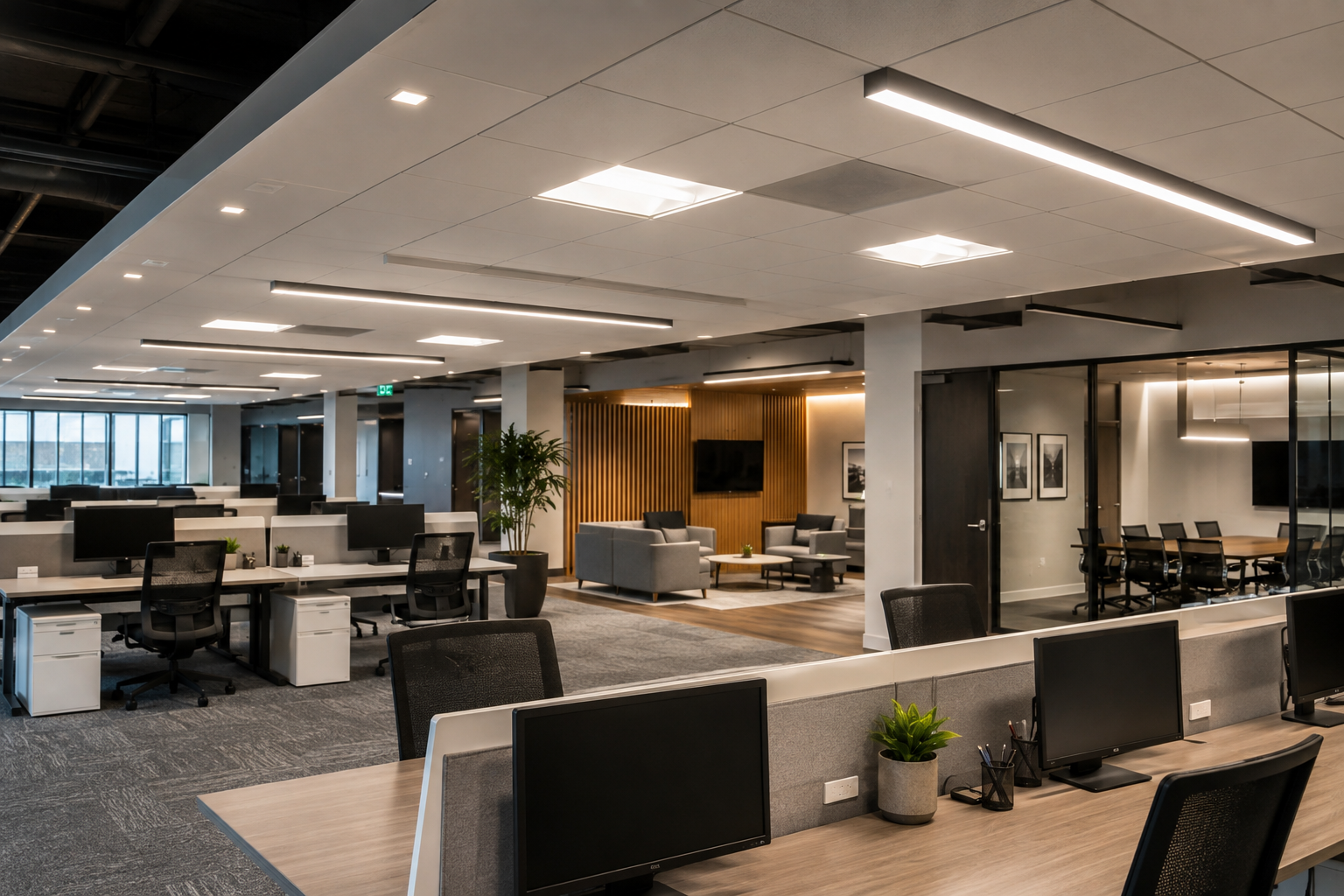
Commercial Indoor Lighting Designed Around Your Space, Application & Objectives
Commercial buildings rarely rely on a single type of lighting. A warehouse may require high-output illumination across open storage areas while offices within the same facility use recessed, linear or drop-ceiling lighting. Corridors may require surface-mounted fixtures, production areas may need durable industrial lighting, and reception or collaborative spaces may benefit from more architectural solutions.
LEDTOMORROW helps commercial and industrial customers evaluate these different requirements as part of a complete indoor lighting strategy. We can help identify appropriate lighting types, evaluate layouts, consider photometric performance, plan retrofits and determine how different fixture families can work together throughout the facility.
Commercial Indoor Lighting Is More Than Choosing a Fixture
The right indoor lighting solution depends on what happens beneath it. Ceiling height, ceiling construction, room dimensions, work activities, equipment, architectural goals, environmental conditions and operating schedules all influence which lighting approach makes sense.
A high-bay environment can require a completely different distribution strategy than a nine-foot office ceiling. A food-processing or washdown area may place different demands on a fixture than a conventional stockroom. An architectural lobby may require the lighting to become part of the visual design, while an industrial aisle may place greater emphasis on distribution, durability and visibility.
LEDTOMORROW works with customers to understand these differences before identifying an appropriate path forward. The result can be a more coordinated lighting system rather than a collection of unrelated fixtures installed throughout the building.
Indoor Lighting Solutions for Different Commercial Environments
Commercial interiors may use several fixture families within the same facility. Understanding the purpose and characteristics of each type can help determine where it fits into the overall lighting design.
Architectural Lighting
Linear fixtures, cylinders and other architectural forms can combine functional illumination with visual design in offices, lobbies, conference areas, retail environments and contemporary commercial interiors.
High Bay Lighting
High-ceiling facilities such as warehouses, manufacturing plants, gymnasiums and distribution centers require lighting designed to deliver usable illumination from greater mounting heights.
Surface-Mounted Lighting
Wraparound fixtures, strip lights and other surface-mounted solutions can provide practical illumination where recessed or suspended installation is not appropriate.
Vapor Tight Lighting
Enclosed lighting solutions can be used in environments where moisture, dust, dirt or demanding operating conditions require additional protection.
Drop Ceiling Lighting
LED panels, troffers and recessed fixtures can integrate directly into suspended ceiling systems used throughout offices, schools, healthcare, retail and other commercial interiors.
Recessed Lighting
Recessed downlights, canless fixtures and other ceiling-integrated solutions can provide clean illumination while minimizing the visual presence of the fixture.
Linear Lighting, Cylinders & Architectural Fixture Solutions
In many modern commercial interiors, lighting is expected to contribute to the architecture as well as illuminate the space. Architectural fixtures can create deliberate lines, visual rhythm and focal points while delivering the light required for everyday use.
LEDTOMORROW can help evaluate architectural lighting strategies for areas where fixture appearance is important. Suspended linear runs can visually organize an open office or collaborative environment. Cylinders can provide clean, directional illumination in entrances, corridors and public spaces. Wall-mounted and decorative architectural solutions can complement the surrounding construction while supporting the overall lighting plan.
The objective is to coordinate appearance and performance. A fixture should not be selected only because it looks appropriate in the space; distribution, output, mounting height, spacing, glare and control should also support the intended application.
Architectural lighting may include:
- ✓ Suspended linear lighting
- ✓ Continuous linear lighting systems
- ✓ Direct and indirect linear illumination
- ✓ Surface-mounted linear fixtures
- ✓ Suspended cylinders
- ✓ Surface-mounted cylinders
- ✓ Architectural downlighting
- ✓ Wall-mounted architectural lighting
- ✓ Accent and feature lighting
- ✓ Integrated lighting for modern commercial spaces
Direct / Indirect Lighting
Architectural linear systems can also combine downward task illumination with indirect light directed toward the ceiling. In appropriate spaces, this can reduce the visual dominance of individual fixtures and create a broader sense of ambient illumination throughout offices, conference spaces, lobbies and other finished commercial interiors.
High Bay Lighting for Warehouses, Manufacturing & Large Interior Spaces
High bay lighting is designed for commercial and industrial spaces where fixtures are mounted substantially above the occupied floor. These applications require careful consideration of mounting height, distribution, fixture spacing, aisle configuration and the visual tasks occurring below.
LEDTOMORROW can help customers determine how high-bay lighting should be applied based on the facility rather than simply replacing an older HID fixture with a new LED unit of similar appearance.
Round & UFO High Bay Lighting
Compact round high bays are commonly used in warehouses, manufacturing facilities and open industrial spaces. Proper selection depends on mounting height, required distribution, floor activity and desired illumination.
Linear High Bay Lighting
Linear high bays can provide broad coverage and are frequently considered for warehouses, production areas, distribution environments and spaces where fixture geometry or distribution aligns better with the building layout.
Washdown & Specialized High Bays
Facilities exposed to moisture, dust or more demanding operating conditions may require high-bay solutions constructed specifically for those environments. Application conditions should be considered during planning.
High Bay Retrofit Strategies
Existing HID, fluorescent or other high-bay systems can often be modernized, but the best approach may involve reevaluating fixture quantity, distribution and spacing rather than automatically preserving the original layout.
Practical Lighting Solutions for Finished & Utility Spaces
Surface-mounted lighting remains one of the most versatile approaches for commercial interiors. These fixtures can be installed directly to ceilings or other mounting surfaces when recessed installation is unavailable, unnecessary or inconsistent with the construction of the facility.
LEDTOMORROW can help identify surface-mounted lighting types based on ceiling conditions, desired distribution, environmental exposure and the activity taking place in the space.
Wraparound Lights
Wraparound fixtures provide broad general illumination and can be appropriate for schools, offices, corridors, utility areas, storage rooms, workshops and numerous other commercial environments.
LED Strip Lights
Strip lighting provides a straightforward linear solution for storage areas, utility spaces, workshops, back-of-house areas and commercial locations where efficient general illumination is the priority.
Surface-Mounted Linear Fixtures
Linear surface fixtures can provide a cleaner architectural appearance than traditional utility fixtures while maintaining the practical advantages of direct ceiling installation.
Lighting for Moisture, Dust & Demanding Indoor Conditions
Not every commercial interior is a clean, conditioned office environment. Parking structures, food-processing areas, industrial spaces, utility rooms, washdown locations, maintenance facilities and other demanding applications may expose lighting equipment to moisture, dust, dirt or other conditions that require a more protective fixture construction.
Vapor tight lighting encloses the light source and internal components within a sealed housing. The exact suitability of a fixture depends on its ratings and the conditions of the project, so LEDTOMORROW evaluates the application before helping identify an appropriate fixture type.
Common considerations include:
- ✓ Moisture exposure
- ✓ Dust and airborne debris
- ✓ Washdown conditions
- ✓ Temperature
- ✓ Mounting height
- ✓ Fixture access
- ✓ Required illumination
- ✓ Environmental ratings
- ✓ Control requirements
LED Panels, Troffers & Recessed Solutions for Suspended Ceilings
Suspended grid ceilings are common throughout offices, schools, healthcare facilities, retail environments and institutional buildings. These ceilings provide several ways to integrate lighting directly into the architecture while maintaining access to mechanical and electrical systems above the grid.
LEDTOMORROW can help determine which ceiling-integrated lighting approach best aligns with the appearance, illumination requirements and retrofit conditions of the facility.
LED Panel Lights
Flat LED panels create a clean, contemporary ceiling appearance and distribute light across a broad luminous surface. They are frequently used in offices, schools, conference areas and other commercial interiors with suspended grids.
LED Troffer Lighting
Troffers remain a familiar commercial ceiling solution and can provide a range of optical distributions and visual styles. LED troffers are commonly used for both renovation and new construction applications.
Recessed Downlights
Recessed downlights can be integrated into suspended ceilings for corridors, lobbies, conference spaces, reception areas and locations where more focused illumination or a less grid-dominant appearance is desired.
Retrofit Opportunities
Existing fluorescent ceiling systems can often be modernized in several ways. The best strategy depends on the condition of the existing fixtures, ceiling configuration, project budget, desired appearance and lighting performance.
Clean Ceiling Integration for Offices, Corridors & Public Spaces
Recessed lighting places much of the fixture above the finished ceiling, allowing the illuminated opening to become the primary visible element. This can create a clean architectural appearance while supporting a variety of general, accent and task-lighting requirements.
Commercial recessed solutions can range from compact downlights and canless fixtures to larger aperture systems, adjustable lighting and specialized architectural configurations. LEDTOMORROW can help evaluate aperture size, distribution, spacing, ceiling conditions and visual objectives when developing a recessed lighting strategy.
Recessed lighting applications may include:
- ✓ Office corridors
- ✓ Reception areas
- ✓ Conference rooms
- ✓ Hospitality spaces
- ✓ Retail environments
- ✓ Commercial lobbies
- ✓ Restrooms and support spaces
- ✓ Accent and perimeter lighting
- ✓ Architectural interiors
Commercial Buildings Often Require More Than General Ceiling Lighting
A complete indoor lighting strategy can include several additional fixture types depending on how the facility is designed and used.
Stairwell Lighting
Stairwells require consistent illumination across landings, stairs and access points. Controls may also help adjust lighting during periods of low occupancy.
Undercabinet & Task Lighting
Supplemental task lighting can provide focused illumination at work surfaces, counters, laboratories, offices and other locations where ambient lighting alone may not provide the desired visibility.
Wall-Mounted Interior Lighting
Wall-mounted fixtures can support corridors, transitional spaces, stairwells, architectural interiors and applications where ceiling-mounted lighting is not the only source of illumination.
Track & Accent Lighting
Adjustable track and accent lighting can highlight displays, architectural features, artwork or focal points in retail, hospitality and commercial environments.
Low Bay & Utility Lighting
Lower mounting heights in utility, industrial and back-of-house areas may benefit from fixture types designed around practical general illumination rather than high-bay distribution.
Specialty Application Lighting
Cold storage, clean environments, food service, hazardous areas and other specialized applications may require lighting selected around specific environmental or operational conditions.
Use Photometric Planning to Match Lighting to the Space
Fixture type alone does not determine whether a commercial lighting system will perform well. Output, optical distribution, mounting height, spacing and room geometry all affect the amount and uniformity of light delivered to the occupied space.
LEDTOMORROW can help customers evaluate proposed commercial indoor lighting layouts using photometric planning where appropriate. This can help identify whether the selected lighting type and layout are expected to provide the desired performance before installation.
Indoor photometric analysis can help evaluate:
- ✓ Estimated illumination levels
- ✓ Fixture spacing
- ✓ Lighting uniformity
- ✓ Mounting heights
- ✓ Work-plane illumination
- ✓ Potential dark areas
- ✓ Excessively bright areas
- ✓ Alternative fixture layouts
- ✓ Retrofit strategies
How Do You Know Which Commercial Indoor Lighting Solution You Need?
Customers do not need to know the exact fixture family before speaking with LEDTOMORROW. In many cases, identifying the right type of lighting is part of the consultation process.
Information about the facility can help narrow the options quickly. Ceiling type, ceiling height, room dimensions, existing fixtures, activity within the space, environmental conditions and desired results can all point toward the most appropriate lighting approach.
What Is the Ceiling Type?
Open structural ceilings, suspended grids, drywall ceilings and exposed industrial environments support different mounting and fixture options.
How High Is the Fixture Mounted?
Mounting height influences distribution, spacing and the type of fixture needed to deliver useful illumination at the occupied level.
What Happens in the Space?
Storage, manufacturing, desk work, meetings, retail activity, circulation and detailed tasks can all create different lighting requirements.
What Are the Existing Conditions?
Existing fixtures, wiring, mounting locations and ceiling infrastructure can influence whether a retrofit, partial redesign or complete lighting redesign is the most practical approach.
Are There Environmental Concerns?
Moisture, dust, temperature, washdown conditions and specialized facility requirements may narrow the range of appropriate lighting types.
What Is the Desired Result?
The project may prioritize energy reduction, improved illumination, lower maintenance, architectural appearance, better controls or a combination of objectives.
Modernize Existing Indoor Lighting Without Assuming One-for-One Replacement
Commercial facilities often accumulate multiple generations of lighting over time. One building may contain fluorescent troffers in offices, older strip fixtures in utility areas, metal halide high bays in a warehouse and outdated recessed lighting in public spaces.
LEDTOMORROW can help evaluate these systems collectively and determine where direct replacement makes sense and where a different lighting type or layout may provide a better result.
Fluorescent Lighting Upgrades
Existing fluorescent troffers, strips, wraps and other systems can be evaluated for LED modernization based on the condition of the fixture and desired result.
HID & Metal Halide Upgrades
Older high-bay and industrial systems can often be replaced with more efficient LED lighting while also reconsidering fixture spacing and light distribution.
Architectural Renovations
Office and public-area renovations can provide an opportunity to move beyond basic fixture replacement and introduce linear, recessed or other architectural lighting solutions.
Whole-Facility Modernization
Larger projects can evaluate multiple interior areas together, allowing fixture types, color appearance, controls and overall lighting performance to be more consistently coordinated.
Pair the Right Lighting With the Right Control Strategy
Commercial indoor facilities rarely operate every area at the same occupancy level throughout the day. Conference rooms, warehouses, aisles, private offices, storage rooms and utility spaces can experience long periods with little or no activity.
LEDTOMORROW can help evaluate how lighting controls may complement the selected fixture types and better align lighting operation with actual facility use.
Indoor lighting controls may include:
- ✓ Occupancy sensing
- ✓ Vacancy sensing
- ✓ Daylight-responsive control
- ✓ Dimming
- ✓ Scheduling
- ✓ Lighting zones
- ✓ Fixture-level controls
- ✓ Wireless lighting management
- ✓ Multi-scene architectural controls
Indoor Lighting for a Wide Range of Commercial Facilities
LEDTOMORROW can help customers evaluate lighting strategies across diverse commercial and industrial building types. Each facility can use a different mix of fixture types depending on architecture, activity and environmental conditions.
Warehouses
High bays, linear fixtures, strip lighting, controls and other industrial solutions can be coordinated around ceiling heights, racks and operating areas.
Manufacturing Facilities
Manufacturing environments may combine high-bay lighting, task illumination, vapor tight fixtures and specialized lighting around production areas.
Commercial Offices
Panels, troffers, recessed lighting, architectural linear fixtures and controls can create comfortable, flexible office environments.
Schools & Institutional Buildings
Classrooms, corridors, gymnasiums, offices and common spaces can require different lighting types within a single facility.
Healthcare Facilities
Healthcare environments can use recessed, ceiling-integrated, architectural and task lighting strategies appropriate to different functional spaces.
Retail & Hospitality
Architectural linear lighting, cylinders, recessed fixtures and accent lighting can combine functional illumination with visual presentation.
From Facility Evaluation to the Right Indoor Lighting Approach
You do not need to begin a project knowing whether you need a high bay, panel, troffer, cylinder, strip fixture, recessed light or architectural linear system. LEDTOMORROW can help identify the lighting types that best align with the application and then develop the project from there.
Understand the Facility
We review ceiling conditions, room dimensions, existing lighting, environmental conditions, facility use and the customer’s objectives.
Identify Suitable Lighting Types
We help narrow the fixture families and lighting approaches appropriate for each area of the building.
Evaluate Layout & Performance
Fixture placement, photometrics, controls and retrofit considerations can be evaluated to help refine the lighting strategy.
Support the Project
LEDTOMORROW can help customers move from initial lighting questions toward a coordinated plan suited to the facility and application.
Commercial Indoor Lighting Questions
What types of commercial indoor lighting are available?
Commercial indoor lighting can include high bays, linear fixtures, cylinders, panels, troffers, recessed downlights, wraparound fixtures, strip lights, vapor tight fixtures, wall-mounted lighting, task lighting and numerous architectural and specialized solutions. The appropriate type depends on the facility and application.
Can LEDTOMORROW help determine what type of lighting my building needs?
Yes. Customers do not need to identify the fixture type before contacting us. LEDTOMORROW can help evaluate the space, ceiling conditions, existing lighting, intended use and project objectives to narrow the appropriate lighting options.
What lighting works best with a commercial drop ceiling?
Suspended ceiling systems can support several approaches including LED panels, troffers and recessed lighting. The best choice depends on the desired appearance, lighting performance, existing ceiling layout and project objectives.
When are high bay lights appropriate?
High bay lighting is generally considered for higher-ceiling commercial and industrial spaces such as warehouses, manufacturing facilities, distribution centers and gymnasiums. Mounting height, distribution and the activity below should be considered when planning the system.
What is the difference between panel lights and troffers?
Both can integrate with suspended ceiling grids, but they differ in construction, optical design and visual appearance. LED panels typically present a flatter, broad luminous surface, while troffers can use deeper optical systems and a more traditional commercial fixture form.
Where are vapor tight lights commonly used?
Vapor tight fixtures can be appropriate in areas exposed to moisture, dust, dirt or demanding environmental conditions. The specific fixture should be selected according to its ratings and the conditions of the application.
Can architectural lighting still be energy efficient?
Yes. Architectural appearance and energy efficiency are not mutually exclusive. Modern LED linear fixtures, cylinders, recessed systems and controls can provide both visual design and efficient operation when properly applied.
Can an existing commercial building be converted to LED without replacing every fixture?
The best retrofit approach depends on the existing system. Some fixtures may be candidates for retrofit while others may be better replaced or incorporated into a redesigned layout. LEDTOMORROW can help evaluate the available options.
Can you provide photometric layouts for commercial indoor lighting?
LEDTOMORROW can help with photometric planning to evaluate estimated illumination, fixture spacing, uniformity and layout performance before installation.
Not Sure Which Indoor Lighting Type Is Right for Your Facility?
You do not have to sort through high bays, panels, troffers, linear fixtures, cylinders, recessed lighting, vapor tight fixtures and every other commercial lighting option on your own. Tell LEDTOMORROW about your facility, ceiling conditions, existing lighting and project goals, and we can help identify the lighting types and overall approach that make sense for your application.