
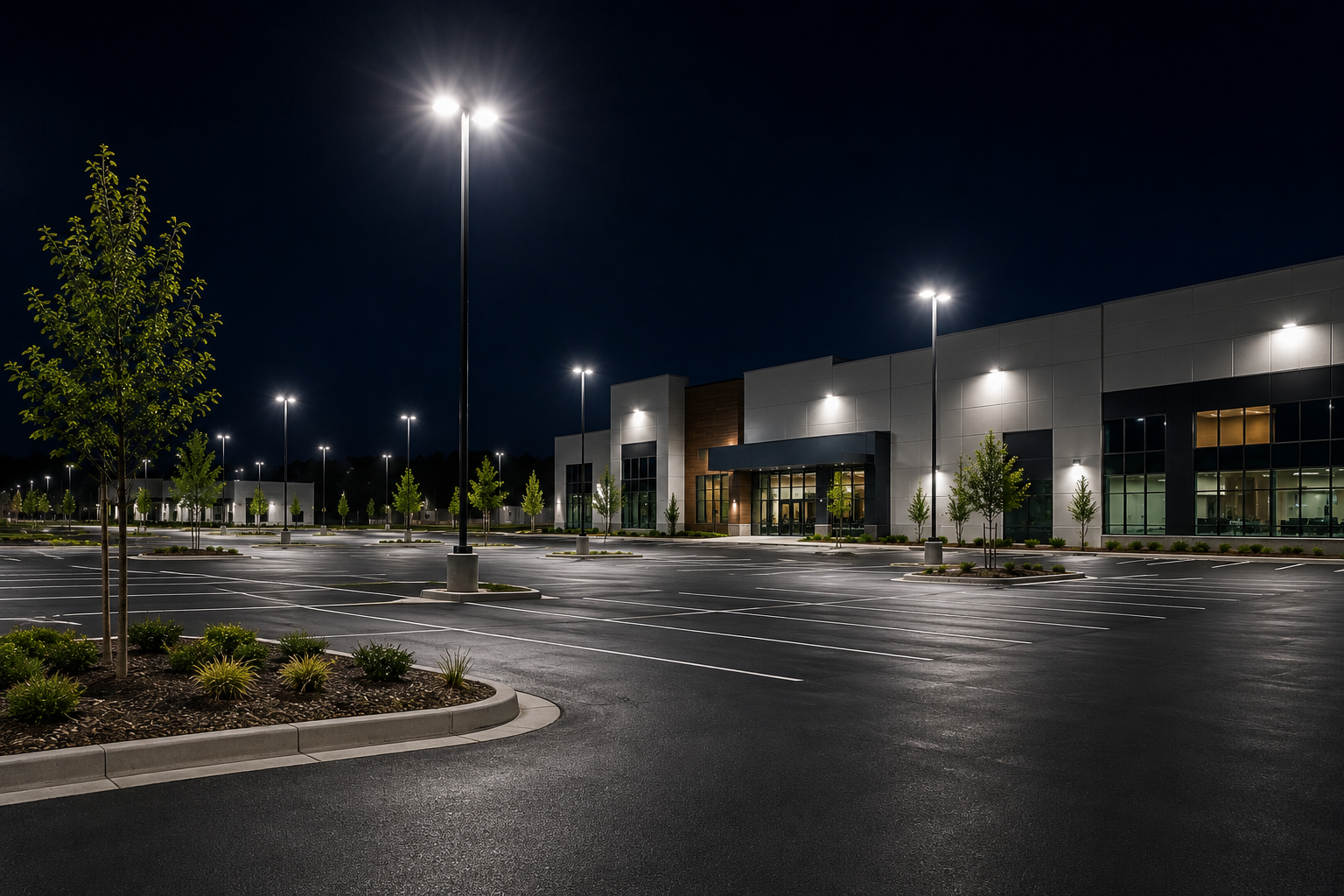
Parking Lot Lighting Designed for Visibility, Uniformity & Efficiency
Parking lots are one of the most visible parts of a commercial property after dark. Drivers, pedestrians, employees and visitors rely on consistent illumination to navigate vehicle lanes, parking spaces, sidewalks and building approaches. LEDTOMORROW helps businesses develop parking lot lighting strategies around the size, layout and operating conditions of the property rather than relying on a generic fixture replacement plan.
Whether you are modernizing aging pole-mounted lighting, correcting dark areas, improving overall uniformity, evaluating photometric layouts or planning lighting for a new property, LEDTOMORROW can help develop a site-specific approach focused on useful illumination, controlled distribution and long-term efficiency.
A More Strategic Approach to Commercial Parking Lot Lighting
Effective parking lot lighting is not simply a matter of installing the brightest fixture available. Pole height, pole spacing, property dimensions, drive lanes, landscaped islands, building locations and pedestrian routes all influence how light is distributed across a site.
A parking lot may have adequate light directly beneath each pole while still containing dark areas between poles, excessive brightness near property edges or inconsistent illumination across pedestrian routes. These problems are often the result of layout and distribution rather than insufficient fixture output.
LEDTOMORROW evaluates the complete site so lighting can be planned around real conditions. The goal is to create useful coverage across the property while controlling glare, limiting unnecessary spill light and reducing the energy and maintenance requirements associated with exterior lighting.
What We Consider When Planning Parking Lot Lighting
Parking areas vary significantly in size, geometry, pole placement and surrounding conditions. A professional lighting strategy should account for the complete property rather than treating each pole as an isolated source of light.
Pole Height & Spacing
Mounting height and spacing have a major effect on lighting distribution. Properly coordinated poles can provide broader, more uniform coverage while reducing extreme bright and dark areas throughout the parking lot.
Parking & Drive-Lane Layout
Parking rows, traffic lanes, entrances and turning areas should be considered together. The lighting design should support the way vehicles actually move through the property after dark.
Pedestrian Routes
Sidewalks, crosswalks and routes between parked vehicles and building entrances benefit from consistent illumination that helps pedestrians remain visible as they move through the site.
Uniformity & Dark Areas
Large differences between maximum and minimum light levels can create an uncomfortable visual environment. Parking lot lighting should focus on balanced coverage rather than isolated areas of excessive brightness.
Property Boundaries
Fixture placement and optical distribution should help keep illumination on the intended property and reduce unnecessary spill toward neighboring buildings, roadways or residential areas.
Landscaping & Site Obstructions
Mature trees, landscaped islands, signs, structures and other obstructions can interfere with light distribution. These conditions should be considered when evaluating pole locations and lighting coverage.
Photometric Planning for Parking Lots
Photometric analysis is one of the most valuable tools in parking lot lighting design. It allows a proposed layout to be evaluated before installation by modeling estimated light levels throughout the site.
LEDTOMORROW can help evaluate pole locations, mounting heights, fixture distribution and overall coverage to determine how a proposed lighting strategy is expected to perform. This can help identify dark areas, excessive intensity and poor uniformity before equipment is installed.
Photometric planning is particularly valuable during retrofit projects because the best LED solution may not simply duplicate the performance characteristics of the older lighting system.
Parking lot photometrics can help evaluate:
- ✓ Average illumination across the property
- ✓ Minimum light levels
- ✓ Maximum-to-minimum relationships
- ✓ Overall lighting uniformity
- ✓ Pole spacing and mounting height
- ✓ Drive lanes and parking rows
- ✓ Pedestrian and sidewalk areas
- ✓ Potential spill light at property boundaries
Good Parking Lot Lighting Is About More Than Brightness
A property can appear extremely bright and still have poor lighting. When fixtures produce intense pools of light directly beneath poles followed by dark areas between them, drivers and pedestrians are continually adapting between different brightness levels.
A better lighting strategy focuses on delivering useful illumination across the entire site. LEDTOMORROW evaluates spacing, distribution and light levels to help create a more consistent nighttime environment.
Reduce Dark Zones
Proper pole spacing and distribution can help reduce poorly illuminated areas between fixtures and around the perimeter of parking rows.
Control Excessive Hot Spots
High light levels directly beneath poles do not necessarily improve the overall quality of the site. Balanced distribution can provide more useful illumination with less extreme contrast.
Improve Visual Adaptation
More consistent lighting can reduce abrupt transitions between bright and dark areas as vehicles and pedestrians move through the property.
Create a More Professional Site
Uniform illumination contributes to a cleaner, more intentional nighttime appearance and can improve how customers and visitors perceive the property.
Direct Light Toward the Property, Not Into the Night Sky
Exterior lighting should place useful illumination on parking surfaces, pedestrian routes and other intended areas while minimizing unnecessary light above the fixture or beyond the site.
Fixture distribution, mounting height, orientation and output all influence how much light reaches neighboring properties and how bright fixtures appear from different viewing angles. LEDTOMORROW considers these factors when evaluating site lighting.
Thoughtful light control can help address:
- ✓ Glare visible to drivers
- ✓ Excessive brightness near building entrances
- ✓ Light trespass onto adjacent properties
- ✓ Unnecessary upward illumination
- ✓ Roadway-facing fixture locations
- ✓ Residential property boundaries
- ✓ Uneven perimeter coverage
- ✓ Over-lighted portions of the site
Modernize Aging Parking Lot Lighting Systems
Many commercial parking areas still operate with older metal halide, HID or high-pressure sodium lighting. As these systems age, light output can decline, color can become inconsistent and maintenance requirements can increase.
LEDTOMORROW can help evaluate existing pole locations, mounting heights and site conditions to determine how an LED upgrade should be approached. In some properties, existing poles can support an effective retrofit strategy. In others, adjustments to fixture output, distribution or layout may provide a better result.
Improve Site Coverage
A retrofit provides an opportunity to correct poor distribution, dark areas and uneven illumination that may have existed with the original system.
Reduce Energy Consumption
Modern LED parking lot lighting can substantially reduce energy use compared with many legacy technologies, particularly when combined with controls.
Reduce Maintenance Requirements
Servicing pole-mounted fixtures often requires lift equipment and specialized access. Longer service intervals can reduce maintenance frequency and associated costs.
Improve Nighttime Appearance
Consistent color and more controlled illumination can give an older commercial property a noticeably cleaner and more modern appearance after dark.
Reduce Parking Lot Energy Use During Low-Activity Hours
Parking areas often remain illuminated for many hours after peak business activity has ended. While appropriate nighttime lighting may still be required, every fixture does not always need to operate at full output throughout the entire night.
LEDTOMORROW can help evaluate control strategies that maintain useful illumination while reducing energy consumption during periods of lower occupancy.
Parking lot controls may include:
- ✓ Dusk-to-dawn photocell operation
- ✓ Time-based scheduling
- ✓ After-hours dimming
- ✓ Occupancy-responsive controls
- ✓ Zone-based lighting control
- ✓ Fixture-level control
- ✓ Wireless lighting management
- ✓ Integration with facility schedules
Coordinate Parking Lot Lighting With the Rest of the Property
Parking lot lighting does not operate independently from building entrances, sidewalks, landscape areas and exterior wall lighting. These systems should work together so people experience a consistent transition as they move from their vehicle toward the building.
LEDTOMORROW considers the relationship between pole-mounted lighting and the rest of the site’s exterior illumination. This can help avoid overly bright transition zones, dark pedestrian paths and unnecessary duplication of light near building entrances.
Building Approaches
Parking areas should transition smoothly into entrance and exterior building lighting so pedestrians do not encounter sudden changes in illumination.
Sidewalks & Crosswalks
Pedestrian routes can be evaluated as part of the overall parking lot layout to help maintain visibility between vehicles and building access points.
Landscape Islands
Trees and landscape features can interfere with pole-mounted lighting as they mature. Site planning should account for both existing and future obstructions.
Property Entrances
Vehicle entrances and exits can be coordinated with the parking lot lighting strategy to support visibility as drivers transition between the property and adjacent roadways.
Lighting Strategies for a Wide Range of Commercial Properties
Parking lot requirements vary depending on property type, operating hours, pedestrian activity and surrounding conditions. LEDTOMORROW can help develop lighting strategies for diverse commercial and institutional environments.
Office & Corporate Properties
Employee and visitor parking can be planned around regular business schedules, pedestrian routes and building entrance locations.
Retail & Shopping Centers
High-activity retail parking areas require consistent illumination across parking rows, storefront approaches and pedestrian crossings.
Industrial Facilities
Manufacturing and warehouse properties may require parking lighting coordinated with shift changes, employee entrances and exterior operational areas.
Healthcare Facilities
Hospitals, clinics and medical properties often operate beyond standard business hours and can benefit from carefully planned pedestrian and vehicle illumination.
Schools & Campuses
Educational properties may require lighting strategies that account for evening events, staff parking, student activity and multiple building entrances.
Hospitality & Mixed-Use Properties
Hotels and mixed-use developments can coordinate parking illumination with architectural and pedestrian lighting to create a more cohesive nighttime environment.
How LEDTOMORROW Approaches Parking Lot Lighting Projects
Every site has different geometry, existing infrastructure and nighttime activity. LEDTOMORROW begins by understanding the property so the lighting strategy can be developed around actual site conditions.
Evaluate the Site
We consider parking layout, existing poles, mounting heights, pedestrian areas, entrances, surrounding properties and current lighting conditions.
Identify Project Goals
Coverage, uniformity, energy use, maintenance concerns, controls and unwanted light spill are considered as part of the project.
Develop the Lighting Strategy
LEDTOMORROW can help develop a site-specific approach incorporating photometrics, pole locations, fixture distribution, retrofit considerations and controls where appropriate.
Support Implementation
We help customers navigate the parking lot lighting project from evaluation and planning through implementation.
Parking Lot Lighting Questions
Can LEDTOMORROW create photometric layouts for parking lots?
Yes. Photometric planning can help evaluate estimated light levels, uniformity, pole spacing, fixture distribution and property coverage before a new lighting system or retrofit is installed.
Can existing parking lot poles be reused during an LED upgrade?
In many projects, existing poles may be suitable for reuse. However, pole height, spacing and location should be evaluated to determine whether the existing layout can provide the desired lighting performance with the proposed system.
Why is lighting uniformity important in a parking lot?
Uniformity describes how consistently light is distributed across the site. Excessive variation between bright and dark areas can make a parking lot less visually comfortable even when the average light level appears sufficient.
Can parking lot lighting be dimmed after business hours?
Depending on the lighting and control system, scheduled dimming, occupancy-based control and other strategies can reduce output during low-activity periods while maintaining appropriate illumination.
How can parking lot lighting reduce light spill onto neighboring properties?
Mounting height, fixture orientation, optical distribution, pole location and output all influence where light travels. Evaluating these factors during photometric planning can help keep illumination focused on the intended property.
Planning a Parking Lot Lighting Upgrade?
From LED parking lot retrofits and pole-mounted area lighting to photometric planning, uniformity improvements and intelligent controls, LEDTOMORROW can help develop a lighting strategy around your property, operating schedule and long-term goals.