
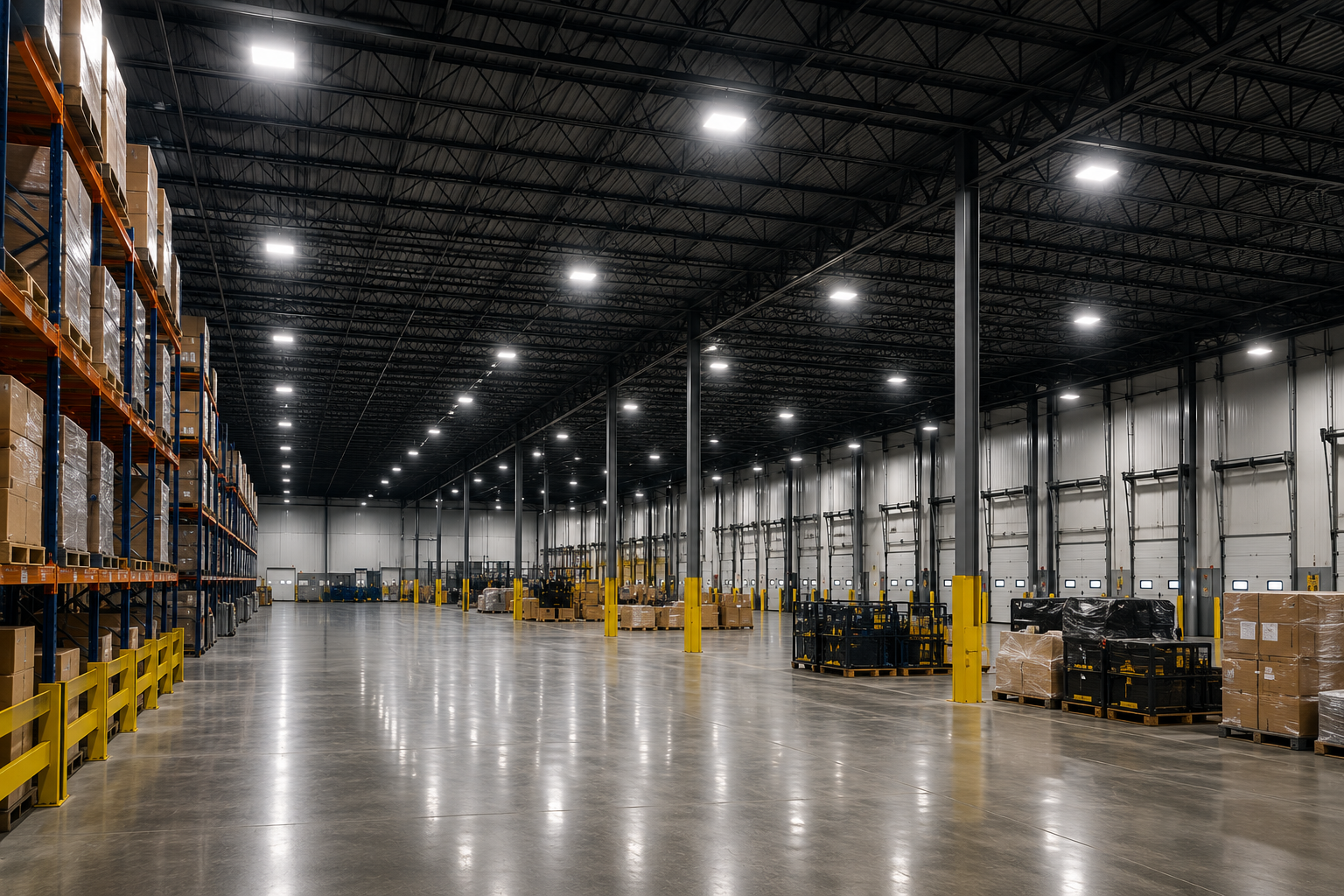
Warehouse Lighting Designed Around Your Facility
Effective warehouse lighting requires more than replacing existing fixtures. Ceiling height, rack configuration, aisle spacing, work areas, mounting locations, operating schedules, safety requirements and energy goals all influence how a lighting system should be designed. LEDTOMORROW helps warehouse and distribution facilities develop lighting strategies built around real operating conditions, with an emphasis on visibility, performance, efficiency and long-term value.
A Better Approach to Warehouse LED Lighting
Warehouses are complex environments. A fixture that performs well in an open distribution area may not deliver the same results in a narrow aisle, loading area, cold-storage environment, maintenance zone or high-rack application. Uniformity, vertical illumination, glare, shadows and light placement can have just as much impact on the usefulness of a lighting system as raw light output.
LEDTOMORROW approaches warehouse lighting from the perspective of the facility itself. We work to understand how the space is used, where employees need light, how material moves through the building and where existing lighting may be creating dark areas, unnecessary energy use or maintenance concerns.
Whether the goal is to modernize an older HID system, replace fluorescent fixtures, improve aisle visibility, incorporate controls or plan lighting for a new facility, our focus is on developing a solution that supports the operation rather than simply changing fixtures one-for-one.
What We Consider When Designing Warehouse Lighting
Every warehouse has different operating conditions. A successful lighting plan should account for the physical environment, employee activity and the way the building is used throughout the day.
Ceiling Height & Mounting Conditions
Higher ceilings require careful consideration of mounting height, beam distribution, fixture spacing and light levels at the work plane. LEDTOMORROW evaluates the relationship between the ceiling and usable floor space so the lighting system is designed for the actual environment.
Rack Layouts & Aisle Configuration
Tall storage racks can block light and create uneven illumination. Narrow aisles, cross aisles and picking locations may require a different lighting strategy than open warehouse areas. Proper placement can improve both horizontal and vertical visibility.
Work Areas & Task Requirements
Receiving, shipping, packing, inspection, inventory and maintenance areas may all require different levels of illumination. Lighting should support the work being performed instead of treating the entire building as one identical environment.
Operating Hours & Energy Goals
A warehouse operating twenty-four hours a day has different energy priorities than a facility with intermittent occupancy. Operating schedules help determine where controls, sensors, scheduling or zoning may provide meaningful savings.
Glare, Shadows & Uniformity
More light does not automatically mean better lighting. Excessive glare, contrast and uneven distribution can make a facility less comfortable and harder to work in. A balanced lighting design focuses on usable illumination throughout the space.
Environmental Conditions
Temperature, moisture, dust, washdown requirements and other environmental factors may influence how a warehouse lighting system should be designed. LEDTOMORROW considers the operating environment when developing the overall lighting strategy.
Photometric Planning for Better Coverage
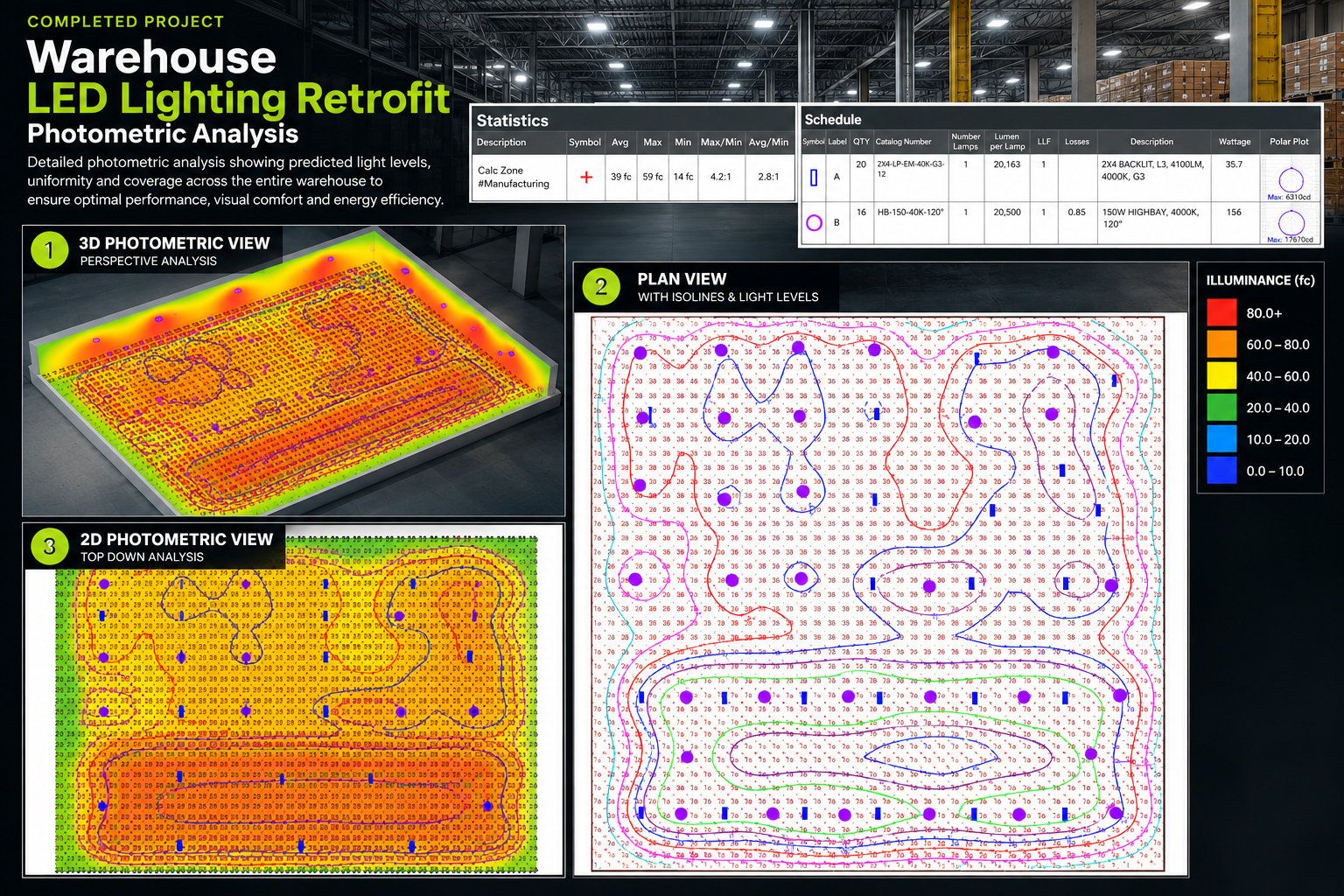
Photometric analysis allows a lighting plan to be evaluated before installation. Instead of estimating whether a proposed layout will provide the desired results, photometric modeling can help visualize light levels, fixture placement, uniformity and coverage throughout a warehouse.
LEDTOMORROW can help evaluate proposed lighting layouts and develop strategies around the dimensions and operating requirements of the facility. This is especially valuable in large warehouses, high-ceiling environments, narrow aisles and facilities where consistent illumination is critical.
Photometric planning can help evaluate:
- ✓ Average and minimum illumination levels
- ✓ Lighting uniformity throughout the facility
- ✓ Fixture spacing and mounting locations
- ✓ High-rack and narrow-aisle coverage
- ✓ Potential dark areas and excessive contrast
- ✓ Light distribution across work and traffic areas
- ✓ Proposed retrofit layouts before installation
- ✓ Opportunities to reduce unnecessary fixture quantities
Upgrade Existing Warehouse Lighting Without Starting From Scratch
Many warehouses still operate with older HID, metal halide, fluorescent or other conventional lighting systems. These systems may consume significant energy, require frequent maintenance and produce inconsistent illumination as lamps and components age.
LEDTOMORROW helps facilities evaluate practical upgrade strategies based on the existing infrastructure and the performance goals of the building. In some facilities, a direct replacement approach may make sense. In others, a revised layout may provide better coverage with fewer fixtures or allow the lighting system to perform more effectively.
Reduce Energy Consumption
LED technology can significantly reduce lighting-related energy use compared with many traditional warehouse lighting systems, particularly when combined with thoughtful fixture selection and controls.
Lower Maintenance Requirements
Longer service life can reduce the frequency of lamp changes and fixture maintenance, which is especially valuable in facilities where accessing high-mounted lighting requires lifts or operational interruptions.
Improve Lighting Quality
A properly planned LED retrofit can improve consistency, visibility and overall lighting quality throughout warehouse aisles, staging areas, loading zones and workspaces.
Support Future Controls
Modernizing the lighting system creates opportunities to incorporate occupancy sensing, scheduling, zoning and other control strategies that can further reduce unnecessary energy use.
Use Light Where and When It Is Needed
Warehouses often contain areas that are not continuously occupied. Storage aisles, secondary rooms, staging areas and portions of larger facilities may experience long periods with little activity. Keeping every fixture at full output during those periods can create unnecessary energy expense.
LEDTOMORROW can help customers evaluate lighting-control strategies that better match illumination with actual facility use.
Control strategies may include:
- ✓ Occupancy and motion sensing
- ✓ Daylight-responsive controls
- ✓ Fixture-level control
- ✓ Lighting zones
- ✓ Scheduling
- ✓ Dimming strategies
- ✓ Wireless control systems
- ✓ Facility-wide lighting management
Warehouse Lighting Should Support the Entire Operation
Lighting is an operational system, not just a building component. The quality of illumination can influence how comfortably employees move through the facility, identify inventory, read labels, operate equipment and perform detailed tasks.
Improved Visibility
Better illumination can make aisles, storage locations, work surfaces and equipment easier to see, helping create a more functional working environment.
More Consistent Illumination
Thoughtful fixture placement and lighting design can reduce dark areas, excessive contrast and uneven coverage throughout the warehouse.
Reduced Operating Costs
Efficient LED lighting, controls and reduced maintenance requirements can help lower the long-term cost associated with operating the facility.
Greater Flexibility
Modern lighting systems can be better adapted to changes in rack configuration, occupancy patterns, operating schedules and future facility requirements.
How LEDTOMORROW Helps Warehouse Customers
Our goal is to help customers make informed lighting decisions based on their facility, objectives and operating environment. Rather than approaching every project with the same predetermined solution, LEDTOMORROW works to understand the building before recommending a path forward.
Understand the Facility
We review the warehouse layout, ceiling heights, existing lighting, operational requirements and areas where improved lighting is needed.
Evaluate the Lighting Strategy
We consider appropriate layouts, lighting performance, retrofit options, photometric requirements and opportunities for controls.
Develop a Facility-Specific Solution
Recommendations are developed around the application rather than forcing the facility into a generic lighting package.
Support the Project
LEDTOMORROW can help customers navigate lighting design, project planning, documentation and implementation as the project moves forward.
Lighting Solutions for Different Warehouse Environments
Warehouse lighting requirements can vary significantly depending on the application. LEDTOMORROW can help evaluate lighting strategies for a wide range of commercial and industrial facilities.
Distribution Centers
Large distribution facilities often require consistent illumination across open areas, rack aisles, staging zones and loading operations.
High-Rack Warehouses
Tall storage systems require careful attention to vertical illumination, fixture placement and beam distribution to support visibility throughout the rack structure.
Cold Storage Facilities
Temperature and environmental conditions can influence how lighting should be selected and planned for refrigerated and freezer environments.
Shipping & Receiving Areas
Loading docks, staging areas and material-handling zones benefit from clear, consistent illumination that supports active warehouse operations.
Manufacturing Warehouses
Combined production and storage facilities may require different lighting strategies for process areas, inventory zones, workstations and material flow.
Maintenance & Utility Areas
Maintenance shops, equipment rooms and support spaces often have different task and illumination requirements than the main warehouse floor.
Warehouse Lighting Questions
How do you determine how much light a warehouse needs?
Lighting requirements depend on factors such as the work being performed, ceiling height, rack configuration, aisle dimensions, existing conditions and desired illumination levels. Photometric analysis can help evaluate whether a proposed layout provides adequate and consistent coverage.
Can LEDTOMORROW help with an existing warehouse retrofit?
Yes. LEDTOMORROW can help evaluate existing lighting conditions and develop a retrofit strategy around the facility’s layout, current infrastructure and performance goals.
Do warehouse lighting upgrades have to be one-for-one replacements?
Not necessarily. In many facilities, evaluating the overall layout can identify opportunities to improve fixture placement, distribution and coverage rather than simply replacing every existing fixture in the same location.
Can lighting controls be added to a warehouse LED system?
Yes. Occupancy sensors, scheduling, zoning, dimming and other controls can be incorporated depending on the application and system design. Controls can be especially useful in areas that experience intermittent occupancy.
Can you provide photometric layouts?
LEDTOMORROW can help customers with lighting-design and photometric planning to evaluate fixture placement, estimated illumination levels and overall lighting coverage before installation.
Planning a Warehouse Lighting Upgrade?
Whether you are replacing an aging lighting system, planning a new warehouse, evaluating photometrics or looking for ways to reduce lighting-related energy use, LEDTOMORROW can help develop a solution around your facility and operational goals.