
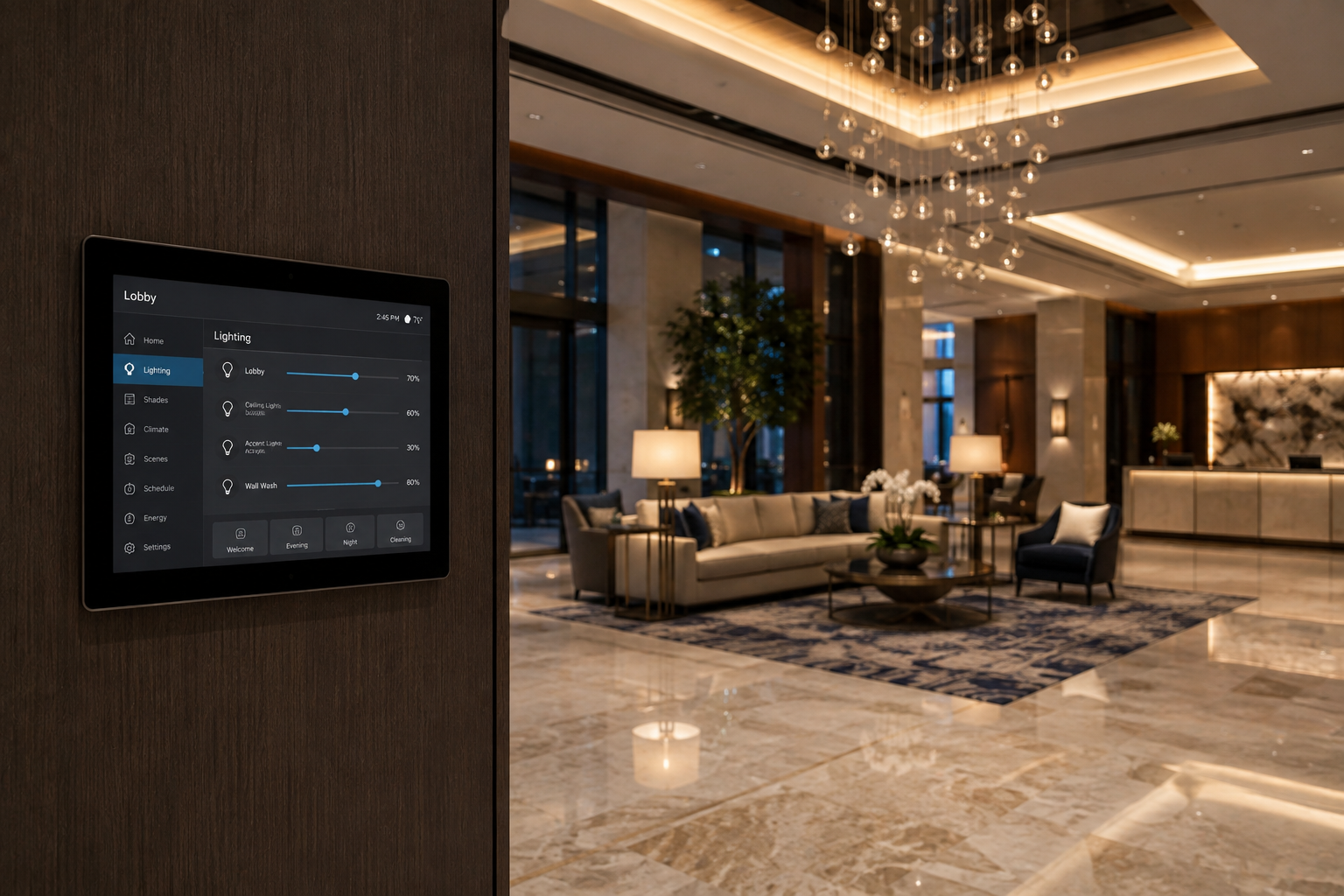
Lighting Controls That Turn Illumination Into an Intelligent Building System
Modern lighting controls can do far more than switch fixtures on and off. Occupancy sensors, daylight-responsive controls, scheduling, dimming, wireless control networks and fixture-level intelligence can allow lighting to respond to the way a facility is actually being used. At a larger scale, networked outdoor lighting can become part of a connected smart-city infrastructure capable of centralized control, monitoring and operational insight.
LEDTOMORROW helps commercial, industrial, institutional and municipal customers evaluate control strategies around the lighting system, application and operational objectives. Whether the project requires a simple occupancy sensor, facility-wide networked controls or a connected outdoor lighting platform, LEDTOMORROW can help identify an approach appropriate for the project.
The Right Control Strategy Depends on the Facility
Lighting controls exist on a spectrum. At one end, a photocell can automatically operate an exterior fixture according to available daylight. At the other, a networked lighting system can provide centralized management of thousands of fixtures across buildings, campuses, roadways or an entire municipality.
The most advanced technology is not automatically the right technology for every project. A storage room may only require occupancy sensing. An office building may benefit from zoning, dimming and daylight response. A warehouse may benefit from fixture-level sensors and high-end trim. A municipal roadway network may justify remote monitoring, scheduling, energy reporting and centralized smart-city management.
LEDTOMORROW helps customers identify the appropriate level of control rather than adding complexity where it provides little practical value.
Control Solutions From Individual Rooms to Entire Properties
Different lighting applications require different levels of automation and intelligence. Many projects combine several of these approaches within the same system.
Occupancy Sensors
Occupancy sensing allows lighting to respond automatically when people enter or leave an area. It can be especially useful in storage rooms, warehouses, offices, restrooms, corridors and other intermittently occupied spaces.
Daylight Controls
Daylight-responsive systems can reduce electric lighting when windows, skylights or other sources of natural light provide sufficient illumination in the occupied space.
Dimming Controls
Dimming allows lighting output to be adjusted rather than limiting operation to full-on or full-off conditions. This can support energy management, visual comfort and different uses of the same space.
Scheduling
Time-based and astronomical schedules can coordinate lighting operation with business hours, sunrise and sunset, shifts, events or other predictable operating patterns.
Fixture-Level Controls
Individual fixtures or small groups can be equipped with sensing and control capability, allowing the lighting system to respond more precisely to occupancy, daylight or operational requirements.
Networked Lighting Controls
Connected control systems can bring fixtures, sensors, schedules and zones into a centralized interface, providing a broader view of lighting operation across the facility or property.
Provide Light When the Space Is Being Used
Commercial buildings often illuminate areas long after occupants have left. Warehouses may contain inactive aisles, conference rooms can sit empty between meetings and storage or utility spaces may only be occupied for minutes at a time.
Occupancy-based control can reduce this unnecessary operating time by allowing lighting to respond automatically to activity. Depending on the application, sensors may control individual fixtures, defined zones or larger areas of the facility.
LEDTOMORROW can help evaluate sensor placement, coverage, timeout behavior, zoning and the relationship between occupancy controls and the underlying lighting system.
Occupancy control can be considered for:
- ✓ Warehouse aisles
- ✓ Storage rooms
- ✓ Private offices
- ✓ Conference rooms
- ✓ Restrooms
- ✓ Maintenance areas
- ✓ Stairwells
- ✓ Utility spaces
- ✓ Parking structures
Reduce Electric Lighting When Daylight Is Already Doing the Work
Commercial buildings with skylights, glass façades and perimeter windows can receive substantial natural illumination during portions of the day. Without controls, electric lighting may continue operating at full output even when daylight is already providing useful light.
Daylight-responsive controls can adjust electric lighting in response to available natural light. The strategy may involve discrete daylight zones or more granular fixture-level response depending on the building and control system.
Daylight strategies can support:
- ✓ Perimeter office zones
- ✓ Skylit warehouses
- ✓ Educational facilities
- ✓ Atriums and lobbies
- ✓ Retail spaces
- ✓ Healthcare environments
- ✓ Mixed-use commercial properties
- ✓ Large open-plan interiors
Move Beyond Individual Sensors to Connected Lighting
Networked lighting controls connect fixtures, sensors, zones and control devices so they can operate as part of a coordinated system. Instead of configuring every device independently, facility personnel may be able to manage lighting from a centralized interface.
This can create greater flexibility in large facilities where operating schedules change, departments use different areas at different times or lighting needs to be adjusted without physically accessing every fixture.
Centralized Management
Multiple zones, schedules and lighting behaviors can be organized through a central management platform rather than controlled as isolated devices.
System Status & Monitoring
Depending on the platform, connected systems can provide information about lighting status, operating conditions and other system-level data.
Remote Configuration
Schedules, dimming levels, zones and control behaviors can potentially be adjusted from the system interface as facility requirements change.
Energy Management
Connected lighting can help organizations understand how lighting operates and identify opportunities to reduce unnecessary runtime or excessive output.
Turn Lighting Into Part of the Building’s Digital Infrastructure
Because lighting is distributed throughout nearly every occupied area of a commercial building, a networked lighting system can provide a valuable foundation for intelligent building operation.
Sensors and connected fixtures can provide much more granular control than traditional circuit-based lighting. Different areas of a building can respond independently to occupancy, daylight, schedules and operational needs.
Depending on the technology selected for a project, lighting controls may also be able to communicate or integrate with other building systems. The appropriate level of integration depends on the control platform, facility infrastructure and project objectives.
Smart lighting strategies may include:
- ✓ Fixture-level intelligence
- ✓ Wireless control networks
- ✓ Occupancy sensing
- ✓ Daylight response
- ✓ Automated schedules
- ✓ High-end trim
- ✓ Zone-based operation
- ✓ Central dashboards
- ✓ Energy-use information
- ✓ Building-system integration
Connected Outdoor Lighting for Municipalities, Campuses & Large Sites
Smart-city lighting takes networked control beyond an individual building. Streetlights, roadway fixtures, parking areas, pedestrian lighting and other exterior assets can be connected through a communications network and managed from a centralized platform.
Instead of operating thousands of fixtures as isolated dusk-to-dawn devices, a connected lighting network can provide greater control over when and how those fixtures operate. Depending on the platform, operators may be able to adjust schedules and output remotely, view fixture status, track energy information and identify potential faults without relying solely on physical inspection or public reports.
For municipalities and large properties, the lighting network can become part of a broader connected infrastructure strategy rather than remaining a standalone electrical system.
Remote Fixture Management
Connected outdoor fixtures can potentially be monitored and adjusted from a centralized management interface rather than requiring field access for every operational change.
Adaptive Dimming & Scheduling
Output can be adjusted according to time, location, operating policy or other programmed conditions, allowing light levels to better correspond with actual nighttime requirements.
Fault & Status Information
Depending on the system, connected lighting can report operating status and help identify fixtures or network devices that may require attention.
Energy Monitoring
Networked systems can provide greater visibility into lighting operation and energy use, helping organizations evaluate system performance over time.
Asset Management
Connected platforms can help associate lighting assets with locations, configuration information and operating status across a large geographic area.
Scalable Infrastructure
A networked lighting deployment can provide a communications foundation that may support additional compatible sensors or connected technologies as future requirements develop.
From Individual Light Fixtures to a Connected Lighting Network
A smart-city lighting system typically combines field-level control devices with communications infrastructure and management software. The exact architecture varies by manufacturer and project, but the concept is straightforward: lighting assets communicate information instead of operating independently.
Connected Lighting Assets
Streetlights, area lights or other exterior fixtures are equipped with compatible control nodes or intelligent control capability.
Communication Network
Control devices communicate through the network architecture selected for the project, allowing lighting assets to exchange information with the management system.
Central Management
Authorized personnel can use a central platform to manage schedules, lighting levels, groups and other supported system functions.
Operational Insight
Depending on system capability, fixture status, energy information, alerts and other data can help support maintenance and operating decisions.
Smart Lighting Is Not Limited to Public Streets
The same general principles behind municipal smart-city lighting can apply to other large outdoor properties where centralized control and visibility are valuable.
Municipal Streets & Roadways
Connected roadway lighting can allow municipalities to manage large groups of streetlights while gaining greater visibility into system operation.
College & University Campuses
Campuses can coordinate roadway, parking, pedestrian and site lighting across large properties from a more centralized control environment.
Commercial Campuses
Corporate properties and mixed-use developments can use connected controls to manage parking lots, roadways, pathways and exterior areas across multiple buildings.
Industrial Complexes
Large industrial sites can coordinate exterior lighting around yards, roadways, parking, loading zones and other operational areas.
Parking Facilities
Large surface lots and parking structures can benefit from scheduling, occupancy-responsive operation, remote management and zone-based controls.
Parks & Pedestrian Areas
Connected controls can help manage lighting across public pathways, gathering areas and other pedestrian-focused spaces according to schedules and operating requirements.
Know More About the Lighting Network Without Inspecting Every Pole
Traditional outdoor lighting systems can be difficult to monitor across large geographic areas. A failed fixture may remain unnoticed until maintenance staff, residents or facility personnel identify the problem.
Networked lighting introduces the potential for greater system awareness. Depending on the control platform, operators may be able to review fixture status, identify anomalies and prioritize maintenance from a central interface.
That changes lighting from a largely reactive maintenance system into one that can provide more information about its own operation.
A connected system may support:
- ✓ Remote status visibility
- ✓ Fault notifications
- ✓ Operating-hour information
- ✓ Energy reporting
- ✓ Remote schedule changes
- ✓ Remote dimming adjustments
- ✓ Fixture grouping
- ✓ Location-based asset information
- ✓ Maintenance prioritization
Plan the Controls Before Choosing the Technology
Connected lighting systems can differ significantly in communication method, control architecture, software, device compatibility and integration capability. For that reason, the control strategy should be considered early in the project rather than added as an afterthought after the lighting equipment has already been selected.
LEDTOMORROW can help customers evaluate the functional requirements of the project before narrowing the control approach. This can help avoid paying for features the customer does not need while also reducing the risk of selecting a system that cannot support future operational goals.
How Much Control Is Required?
A project may require simple zone control, individual fixture control or centralized management across multiple buildings or geographic areas.
What Information Is Valuable?
Energy information, operating status, fault reporting and asset data may be valuable in some projects while unnecessary in smaller applications.
Who Will Manage the System?
Facility personnel, energy managers, public works departments and other users may require different levels of access and system complexity.
How Might the System Grow?
Projects expected to expand over time should consider scalability, compatibility and the ability to incorporate additional lighting zones or connected devices.
Not Every Outdoor Project Requires a Smart-City Network
Networked controls can provide powerful capabilities, but many commercial exterior projects can achieve their goals with simpler control strategies. LEDTOMORROW can help determine when traditional controls make sense and when the added intelligence of a connected system provides meaningful value.
Photocells
Photocells provide straightforward dusk-to-dawn operation by responding to available outdoor light.
Time Scheduling
Schedules can coordinate lighting with operating hours and reduce unnecessary runtime during predictable low-activity periods.
After-Hours Dimming
Compatible lighting systems can maintain a reduced background level during lower-activity periods instead of operating at full output all night.
Motion-Based Control
Parking areas, loading zones and other exterior spaces may use occupancy detection to increase output when activity is detected.
Zone Control
Different areas of the property can operate independently according to their individual schedules and activity patterns.
Fixture-Level Control
Individual outdoor fixtures can potentially be controlled independently, providing greater flexibility than conventional circuit-level operation.
Smart Controls for Warehouses, Offices & Manufacturing Facilities
Connected lighting is equally valuable indoors. Large commercial and industrial facilities may contain hundreds or thousands of fixtures across areas that operate on different schedules and occupancy patterns.
Instead of treating every fixture as part of a permanently defined electrical circuit, smart lighting can provide more flexible zoning and control. This can be especially useful when layouts, departments or operating schedules change over time.
Warehouse Controls
Fixture-level occupancy sensing, aisle control, scheduling and high-end trim can help align warehouse lighting with actual activity across large facilities.
Manufacturing Controls
Production zones, storage areas, maintenance spaces and support areas can be controlled independently according to operational schedules and occupancy.
Office Controls
Occupancy sensing, daylight response, dimming and scene control can help create more flexible workspaces while managing lighting energy use.
Multi-Building Facilities
Larger campuses can benefit from a coordinated lighting strategy that provides greater visibility and control across multiple facilities or properties.
Lighting Upgrades Are an Opportunity to Add Intelligence
A conversion from conventional lighting to LED creates an opportunity to reconsider how the lighting is controlled. Replacing an older HID or fluorescent fixture without evaluating controls may leave a significant portion of the project’s potential operating efficiency unrealized.
LEDTOMORROW can help customers evaluate whether controls should be incorporated at the same time as the lighting upgrade. Depending on the application, this might be as simple as adding occupancy sensing or as comprehensive as deploying a networked lighting-control system.
A retrofit controls review can consider:
- ✓ Existing switching and circuits
- ✓ Facility operating hours
- ✓ Occupancy patterns
- ✓ Available daylight
- ✓ Dimming capability
- ✓ Sensor opportunities
- ✓ Networked control potential
- ✓ Future expansion
- ✓ Outdoor and indoor integration
Lighting Controls Can Improve How a Facility Is Operated
Energy reduction is an important benefit of lighting controls, but it is not the only reason to consider them. A well-designed control system can provide flexibility, visibility and operational capabilities that conventional switched lighting cannot provide.
Reduced Unnecessary Runtime
Lighting can respond to occupancy, daylight and schedules instead of operating at full output regardless of whether illumination is needed.
Greater Operational Flexibility
Zones, schedules and output levels can be adjusted as departments, layouts, events or facility operating requirements change.
Better System Visibility
Networked platforms may provide information that helps facility personnel better understand how the lighting system is operating.
More Informed Maintenance
Systems with monitoring capabilities may help identify operating issues and support more targeted maintenance across large lighting networks.
Start With the Operational Goal, Then Choose the Control Technology
Customers do not need to know which sensor, wireless protocol, controller or smart-lighting platform they need before contacting LEDTOMORROW. We can begin with how the facility operates and what the customer wants the lighting system to accomplish.
Understand the Application
We evaluate the lighting system, facility or site layout, occupancy, schedules, existing controls and operational priorities.
Define Control Objectives
We identify whether the project needs basic automation, energy management, fixture-level control, remote monitoring or broader networked functionality.
Identify the Appropriate Strategy
LEDTOMORROW can help narrow the controls architecture and capabilities that make sense for the size and complexity of the project.
Support Implementation
We can help customers coordinate lighting and controls as part of a complete commercial, industrial or outdoor lighting project.
Lighting Controls & Smart Lighting Questions
What is a smart lighting control system?
Smart lighting generally refers to lighting that can respond automatically to conditions or communicate through a connected control system. Depending on the project, this can include sensors, scheduling, dimming, wireless control, fixture-level management, remote configuration and system monitoring.
What are smart city lighting controls?
Smart-city lighting controls connect outdoor lighting assets such as streetlights or area lights to a communications and management system. Depending on the platform, authorized operators may be able to remotely monitor fixtures, change schedules or output levels, review energy information and receive information about system status.
Does every lighting project need networked controls?
No. Smaller or straightforward applications may be well served by photocells, occupancy sensors, scheduling or other traditional controls. Networked controls become more valuable when a project benefits from centralized management, fixture-level flexibility, monitoring or large-scale coordination.
Can existing LED lighting be connected to smart controls?
It depends on the existing fixtures, drivers, control interfaces and the system being considered. LEDTOMORROW can help evaluate the existing installation and determine what control options may be practical.
Can warehouse lights dim when an aisle is empty?
Compatible fixtures and controls can use occupancy sensing to reduce output in inactive areas and increase illumination when activity is detected. The exact strategy depends on the facility and selected control system.
Can exterior lighting be controlled remotely?
Yes, when the lighting is part of a compatible networked control platform. Remote capabilities can vary from basic schedule changes to more comprehensive fixture monitoring and management.
What is fixture-level lighting control?
Fixture-level control allows individual luminaires or small groups of luminaires to have their own control capability rather than relying solely on a common electrical circuit for operation.
Can lighting controls report energy use?
Some networked control platforms provide energy-related information and reporting. Available data and accuracy depend on the specific control system and equipment used for the project.
Can smart lighting identify failed fixtures?
Some connected lighting platforms can provide fixture status, fault information or alerts that may help operators identify potential problems. The exact monitoring capabilities depend on the selected system.
Can smart lighting be expanded later?
Many connected lighting systems are designed with expansion in mind, but scalability and device compatibility should be evaluated before the initial system is selected. Planning future requirements early can help avoid limitations later.
Not Sure Which Lighting Control System Fits Your Project?
From occupancy sensors, photocells and daylight controls to wireless facility management and smart-city lighting networks, the available control technologies can become complicated quickly. Tell LEDTOMORROW about your facility, existing lighting, operating schedule and goals, and we can help identify the level of control and smart-lighting functionality that makes sense for your application.