
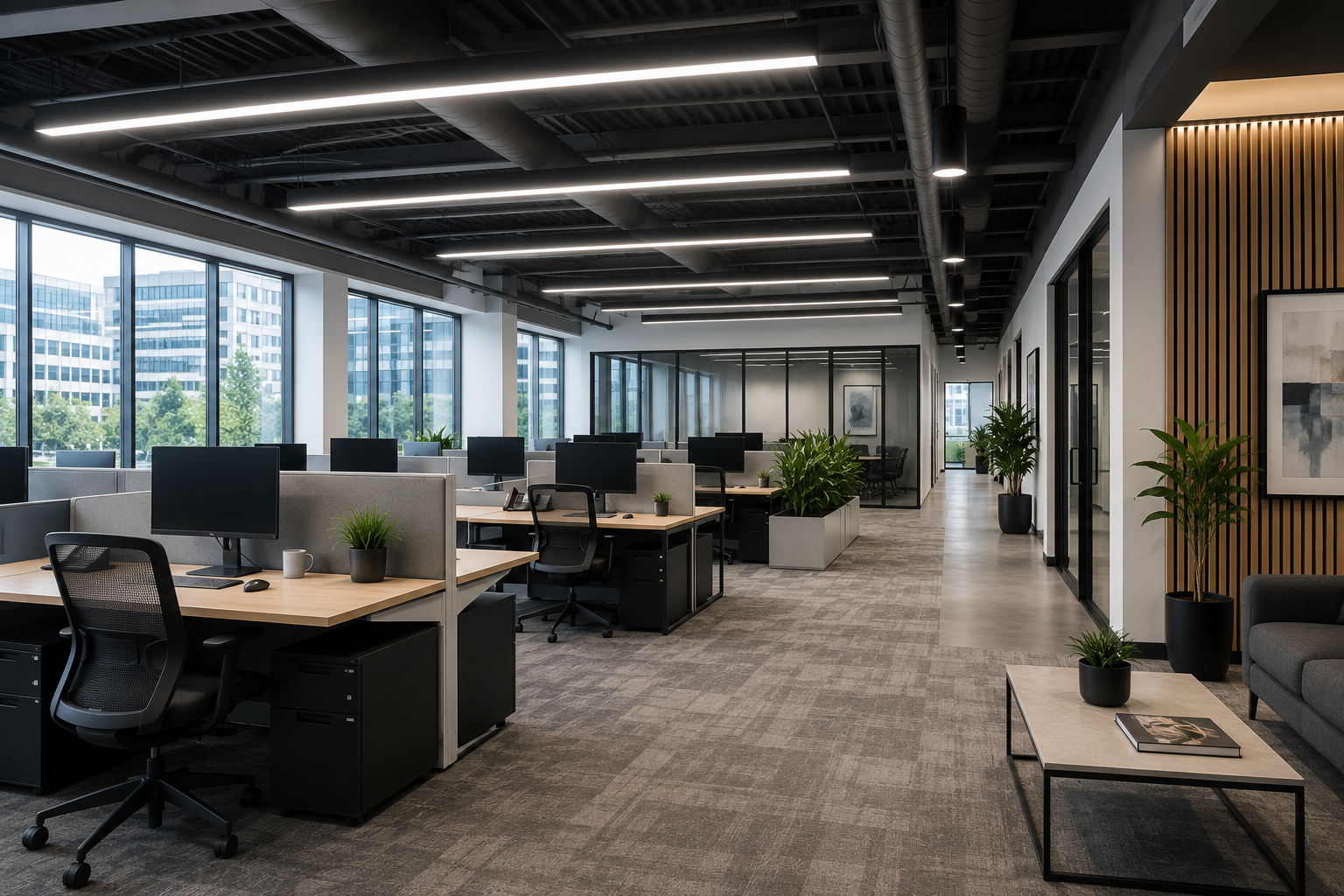
Office Lighting Designed for Comfort, Performance & Efficiency
Office lighting plays an important role in how employees experience and use a workspace. Open offices, private offices, conference rooms, reception areas, corridors, collaborative spaces and support areas can each have different lighting requirements. LEDTOMORROW helps businesses develop office lighting strategies that balance visual comfort, illumination quality, energy efficiency and the architectural character of the space.
Whether you are renovating an existing office, upgrading older fluorescent lighting, planning a new commercial workspace or evaluating lighting controls, LEDTOMORROW can help develop a solution around the way your facility is actually used.
A More Thoughtful Approach to Commercial Office Lighting
Effective office lighting is about more than achieving a certain level of brightness. The quality, distribution and control of light can influence visual comfort, screen visibility, the appearance of the workspace and the overall experience of employees and visitors.
LEDTOMORROW approaches office lighting by considering how different areas of the facility function. A conference room used for presentations may require different control and lighting characteristics than an open workstation area. Reception spaces may place greater emphasis on architectural appearance, while private offices and workstations require comfortable illumination for computer-based and detailed tasks.
By evaluating the entire workspace instead of treating every area identically, lighting can become an integrated part of the office environment rather than simply a utility overhead.
What We Consider When Planning Office Lighting
Modern offices contain a wide range of spaces and activities. A successful lighting strategy considers both the physical environment and the visual needs of the people working within it.
Workstations & Open Offices
Open work environments require balanced illumination across desks, circulation areas and shared spaces. Proper fixture placement can help provide consistent light while reducing excessive contrast and unnecessary glare.
Computer & Screen-Based Work
Reflections and glare can make screen-based work uncomfortable. Office lighting should be planned with fixture placement, brightness and distribution in mind so employees can work comfortably around monitors and other digital displays.
Conference & Meeting Rooms
Conference rooms frequently support multiple activities including meetings, presentations and video conferencing. Flexible lighting and controls can allow the environment to adapt to different uses throughout the day.
Reception & Common Areas
Reception areas, lounges and collaborative spaces often combine functional lighting with architectural and aesthetic considerations. The lighting strategy should support both visibility and the desired appearance of the facility.
Daylight & Window Conditions
Offices with substantial natural light may benefit from lighting strategies that respond to daylight conditions. Proper controls can help reduce unnecessary electric lighting when sufficient daylight is available.
Occupancy & Operating Schedules
Conference rooms, private offices, break rooms and other spaces may remain unoccupied for significant periods. Understanding occupancy patterns can identify opportunities for automatic controls and reduced energy use.
Office Lighting Should Feel Comfortable, Not Overpowering
More illumination does not automatically create a better office environment. Excessive brightness, poorly controlled glare and strong contrast between illuminated and darker areas can make a workspace uncomfortable.
LEDTOMORROW focuses on creating balanced lighting environments that provide useful illumination without overwhelming the space. Fixture placement, light distribution, ceiling conditions, finishes and workstation locations can all influence how employees perceive the lighting around them.
A well-planned office environment can address:
- ✓ Glare around computer monitors
- ✓ Uneven illumination across workspaces
- ✓ Excessive brightness and contrast
- ✓ Shadowing around desks and work surfaces
- ✓ Lighting consistency between adjacent areas
- ✓ Visual comfort in open office environments
- ✓ Presentation and conference-room flexibility
- ✓ Architectural appearance and atmosphere
Photometric Planning for Commercial Office Spaces
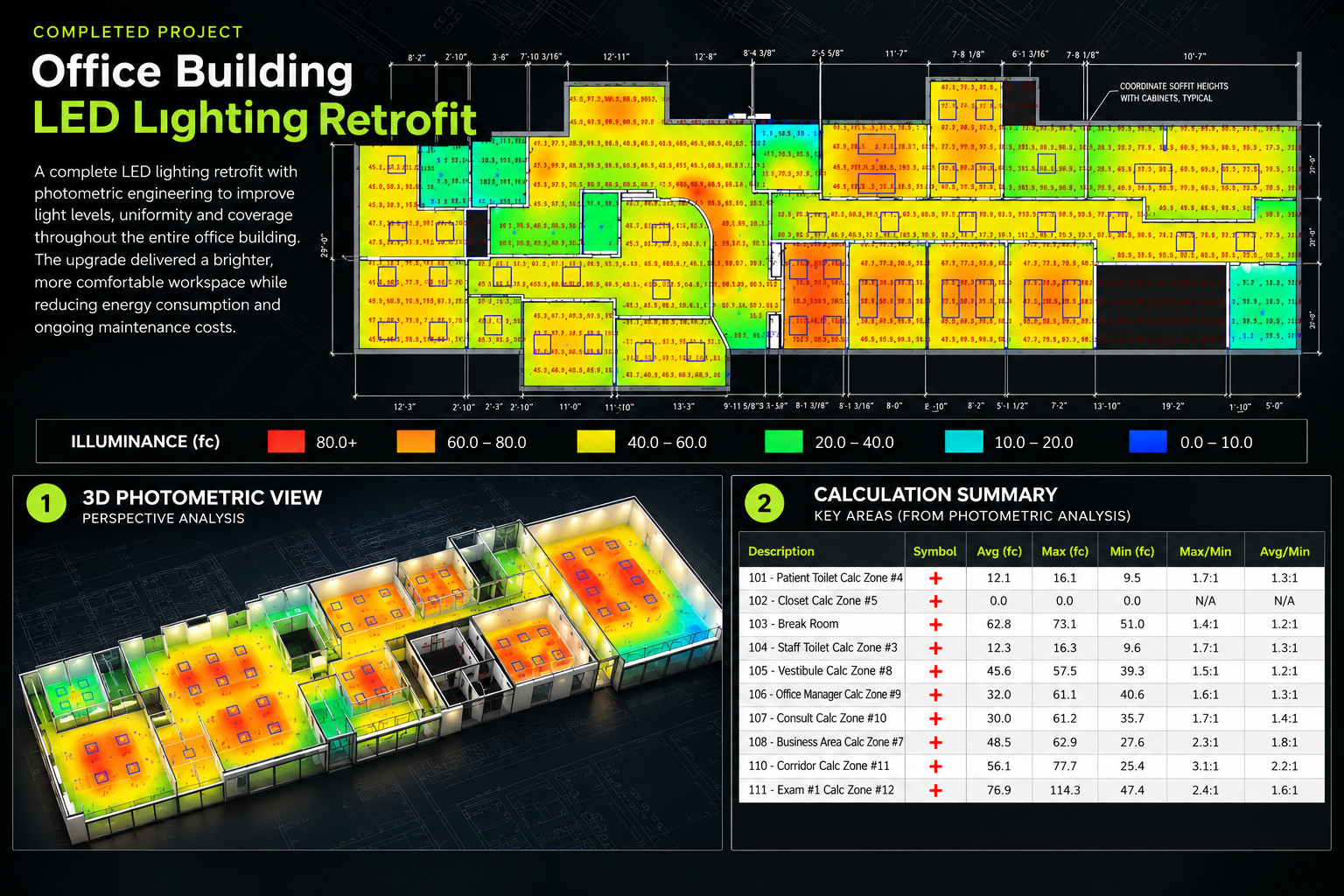
Photometric analysis can help evaluate how a proposed lighting layout will perform before installation. This allows estimated illumination levels, uniformity and fixture placement to be reviewed across workstations, meeting spaces, corridors and other areas of the office.
For larger office renovations and new construction projects, photometric planning can provide useful information when determining fixture quantities, spacing and overall lighting distribution. LEDTOMORROW can help develop a lighting strategy around the dimensions and intended use of the space.
Photometric planning can help evaluate:
- ✓ Estimated illumination levels
- ✓ Lighting uniformity across workstations
- ✓ Fixture spacing and ceiling layouts
- ✓ Conference and meeting areas
- ✓ Corridors and common spaces
- ✓ Reception and lobby lighting
- ✓ Potential under-lit or over-lit areas
- ✓ Proposed renovation layouts before installation
Office LED Lighting Retrofit & Photometric Study
Explore an office lighting project featuring a photometric floor plan, a three-dimensional lighting model and calculated illumination results across individual spaces.
Modernize Aging Office Lighting Systems
Many commercial offices still rely on fluorescent troffers, older recessed fixtures or other conventional lighting systems. Aging systems may produce inconsistent illumination, require frequent lamp replacement and consume more energy than modern lighting strategies.
LEDTOMORROW can help evaluate existing office lighting and determine whether a direct retrofit, revised fixture layout or broader lighting redesign makes the most sense for the facility. The objective is to improve the overall lighting environment while considering energy use, maintenance and long-term flexibility.
Improve Lighting Quality
A well-planned LED upgrade can provide more consistent illumination and create a cleaner, more modern visual environment throughout the office.
Reduce Energy Consumption
Modern lighting systems can reduce lighting-related energy use compared with many legacy technologies, particularly when controls are incorporated into the project.
Lower Maintenance Requirements
Longer service life can reduce the frequency of lamp changes and lighting maintenance, helping minimize ongoing disruption within occupied office environments.
Refresh the Appearance of the Space
Lighting upgrades can contribute to a more contemporary office environment by improving fixture appearance, light quality and consistency throughout the facility.
Make Office Lighting Responsive to How the Building Is Used
Commercial offices are particularly well suited for lighting controls because occupancy and daylight conditions frequently change throughout the day. Conference rooms may sit empty between meetings, private offices may be intermittently occupied and perimeter workspaces may receive significant natural daylight.
LEDTOMORROW can help evaluate control strategies that allow lighting operation to better match real occupancy and environmental conditions.
Office lighting controls may include:
- ✓ Occupancy sensing
- ✓ Vacancy controls
- ✓ Daylight harvesting
- ✓ Automatic scheduling
- ✓ Dimming controls
- ✓ Conference-room scene control
- ✓ Lighting zones
- ✓ Wireless control systems
Lighting Strategies for Every Area of the Workplace
A modern office typically includes several different environments, each with its own functional and visual requirements. LEDTOMORROW can help develop a cohesive lighting strategy while addressing the needs of individual spaces.
Open Office Areas
Open workspaces benefit from consistent illumination, comfortable brightness and careful coordination with workstation and monitor placement.
Private Offices
Private offices can combine general illumination with daylight, task lighting and individual controls to provide greater flexibility for occupants.
Conference Rooms
Meeting spaces may require adjustable lighting to support presentations, collaborative meetings, video conferencing and general use.
Reception & Lobby Areas
Entry spaces can combine functional illumination with architectural lighting to establish a professional first impression for employees and visitors.
Break Rooms & Collaborative Spaces
Informal spaces can use lighting to create a comfortable environment while maintaining appropriate illumination for everyday activities.
Corridors & Support Areas
Hallways, storage areas, copy rooms and other support spaces can be incorporated into the overall system with appropriate illumination and occupancy controls.
Lighting That Supports a Better Office Environment
Office lighting should support the people using the facility while also meeting the operational goals of the organization. A thoughtfully planned system can help create a more comfortable workplace while reducing unnecessary energy and maintenance demands.
Improved Visual Comfort
Balanced illumination can help reduce glare, harsh contrast and other visual conditions that may make workspaces uncomfortable.
Consistent Illumination
Proper fixture placement and distribution can create more uniform lighting across workstations, shared spaces and circulation areas.
Reduced Operating Costs
Efficient LED lighting, controls and lower maintenance requirements can help reduce long-term lighting-related operating expenses.
Greater Workspace Flexibility
Modern lighting systems and controls can adapt more easily as office layouts, occupancy patterns and workplace needs change.
How LEDTOMORROW Approaches Office Lighting Projects
We begin by understanding how the office functions and what the customer wants to improve. This allows the lighting strategy to be developed around the facility rather than forcing every office into the same solution.
Evaluate the Workspace
We consider existing lighting, ceiling conditions, office layouts, workstation locations, natural daylight and the different ways individual spaces are used.
Identify Project Priorities
Lighting quality, visual comfort, energy use, controls, maintenance concerns and architectural objectives are considered as part of the overall project.
Develop the Lighting Strategy
LEDTOMORROW can help develop a coordinated approach incorporating lighting layout, photometric planning, retrofit considerations and controls where appropriate.
Support the Project
We help customers navigate the lighting project from initial evaluation and planning through implementation.
Commercial Office Lighting Questions
Can LEDTOMORROW help upgrade existing fluorescent office lighting?
Yes. LEDTOMORROW can evaluate existing office lighting and help develop an LED retrofit or redesign strategy around the current ceiling system, workspace configuration and project objectives.
How can office lighting help reduce glare around computer screens?
Fixture placement, light distribution, brightness and workstation orientation all influence perceived glare. A properly planned lighting layout can help reduce direct and reflected glare within screen-based work environments.
Can office lighting be controlled automatically?
Yes. Occupancy sensors, daylight-responsive controls, scheduling, dimming and zoning can be used to adjust lighting based on how and when different office spaces are occupied.
Can you provide photometric layouts for office projects?
LEDTOMORROW can help with photometric planning to evaluate proposed fixture placement, estimated illumination levels and lighting uniformity before installation.
Should every area of an office use the same lighting?
Not necessarily. Open offices, conference rooms, reception spaces, private offices and corridors serve different purposes. The overall lighting system can remain visually coordinated while individual areas are designed around their specific requirements.
Planning an Office Lighting Upgrade or Renovation?
From existing office retrofits and lighting controls to photometric planning and complete workplace lighting strategies, LEDTOMORROW can help develop an approach around your building, your employees and your long-term operational goals.