
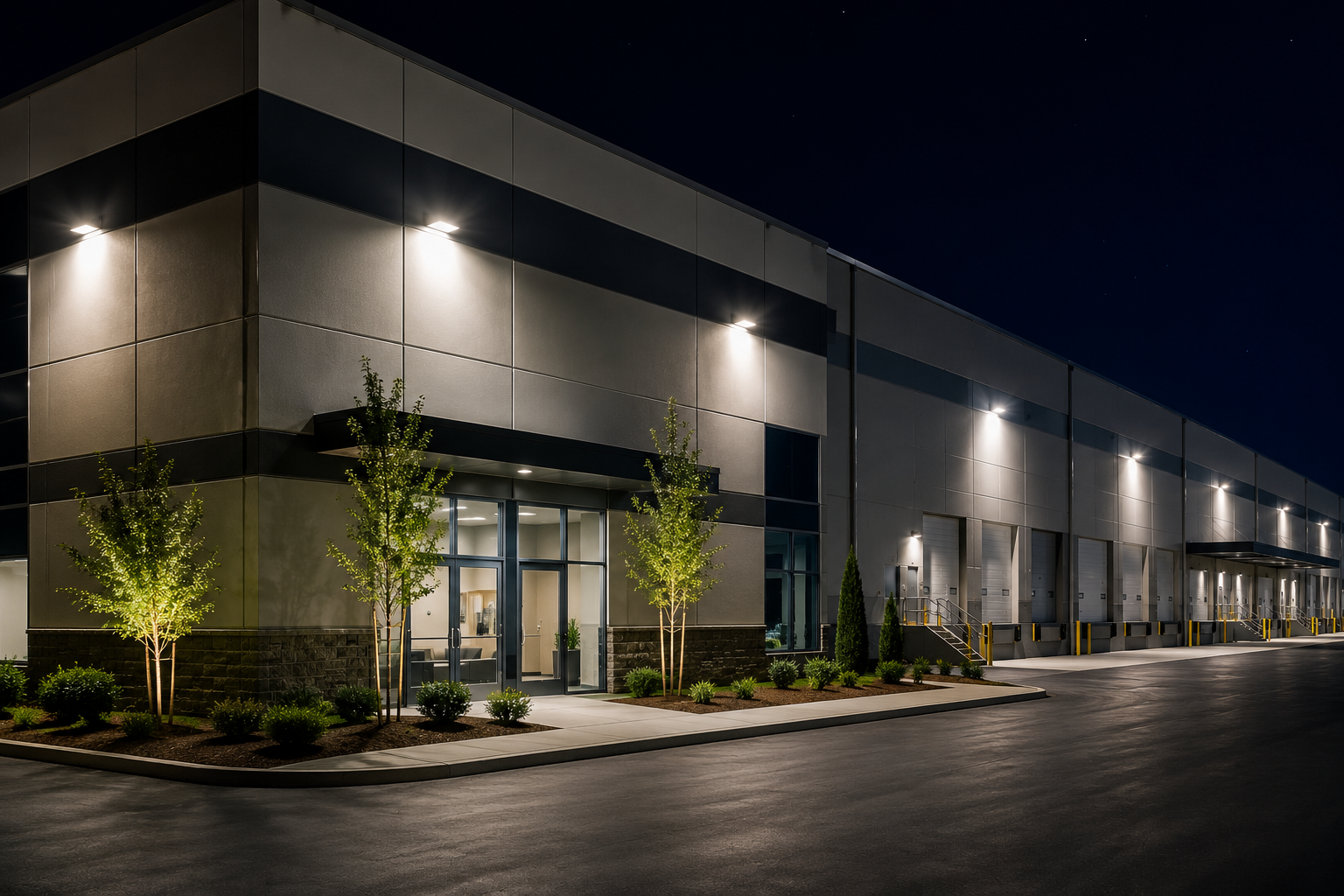
Building Exterior Lighting Designed for Visibility, Safety & Architectural Impact
Exterior lighting plays a critical role in how a commercial or industrial property functions after dark. Entrances, walkways, loading areas, perimeter zones, service doors and building façades all require appropriate illumination, but they do not necessarily require the same lighting strategy. LEDTOMORROW helps businesses develop exterior lighting solutions around the architecture, activity and operating requirements of each property.
Whether you are upgrading aging wall-mounted lighting, improving visibility around entrances and service areas, modernizing the nighttime appearance of a facility or planning exterior lighting for new construction, LEDTOMORROW can help create a thoughtful lighting approach focused on performance, efficiency and long-term value.
A More Complete Approach to Building Exterior Lighting
Exterior lighting should do more than simply make a building visible. It should support people arriving and leaving the property, help define entrances and circulation areas, provide usable illumination around service zones and contribute to the overall appearance of the facility after dark.
LEDTOMORROW evaluates building exterior lighting as part of the entire property. We consider where people walk, where vehicles approach the building, how entrances are identified, where loading or service activity occurs and how the architecture itself affects light placement and distribution.
This broader approach can help eliminate overly bright areas, deep shadows, inconsistent illumination and unnecessary energy use while creating a more professional and intentional nighttime environment.
What We Consider When Planning Exterior Building Lighting
Building type, architecture, mounting height, surrounding activity and property layout all influence how exterior lighting should be designed. A successful solution begins with understanding how the site operates after dark.
Entrances & Building Access
Main entrances, employee doors and service access points should be clearly visible without creating excessive brightness. Lighting can help establish visual hierarchy and make important access points easier to identify after dark.
Perimeter & Façade Illumination
Wall-mounted lighting can provide functional illumination around the building perimeter while also contributing to the architectural appearance of the property. Placement and distribution should complement the building rather than overwhelm it.
Walkways & Pedestrian Areas
Sidewalks, paths and transition areas benefit from consistent illumination that helps pedestrians navigate between parking areas, entrances and surrounding spaces.
Loading & Service Areas
Loading docks, receiving doors, utility areas and service zones may require stronger task-oriented illumination than architectural areas of the building. These spaces should be evaluated around the work being performed.
Mounting Height & Building Geometry
Canopies, wall projections, recessed entrances, architectural features and varying elevations can influence how light reaches the ground and surrounding surfaces. Fixture placement should respond to the actual structure.
Neighboring Properties & Light Spill
Exterior lighting should provide useful illumination on the property while avoiding unnecessary light trespass into neighboring sites, roadways or areas where illumination is not needed.
Photometric Planning for Building Perimeters
Exterior photometric analysis can help evaluate how light will be distributed around a commercial property before installation. This is especially useful when planning wall-mounted lighting because fixture height, spacing and optical distribution can significantly affect illumination on the ground.
LEDTOMORROW can help evaluate proposed exterior lighting layouts around the dimensions, architecture and operating requirements of the site. Photometric planning can help identify areas of excessive brightness, insufficient coverage or poor uniformity before a project reaches installation.
Exterior photometric planning can help evaluate:
- ✓ Illumination around building entrances
- ✓ Perimeter lighting coverage
- ✓ Wall-mounted fixture spacing
- ✓ Walkway and pedestrian illumination
- ✓ Loading and service-area coverage
- ✓ Dark areas around corners and recesses
- ✓ Lighting uniformity around the property
- ✓ Potential spill light beyond property boundaries
Lighting That Complements the Building Instead of Competing With It
Exterior lighting has a major influence on how a property looks after dark. Poorly positioned fixtures can create harsh hot spots, deep shadows and excessive brightness that distract from the architecture. A coordinated lighting approach can provide the necessary illumination while allowing the building itself to remain visually prominent.
LEDTOMORROW considers façade materials, entrances, architectural lines, wall heights and surrounding landscape when evaluating exterior lighting. The goal is to create a balanced nighttime appearance that feels intentional rather than simply illuminated.
Highlight Key Architectural Areas
Entrances, canopies and prominent building features can be visually emphasized while secondary areas receive the functional illumination they require.
Control Excessive Brightness
Good exterior lighting design manages intensity and distribution so walls, entrances and surrounding areas are illuminated without creating distracting glare.
Create Visual Consistency
Coordinated lighting around multiple façades can provide a more cohesive appearance and avoid the patchwork effect created by unrelated fixture types and light levels.
Support Property Identity
Exterior illumination contributes to how customers, employees and visitors perceive a building at night, making lighting an important part of the overall property presentation.
Reduce Dark Areas Around the Building Perimeter
Exterior lighting can improve awareness around entrances, loading areas, walkways, doors and other parts of the property used after dark. Dark corners and abrupt transitions between bright and unlit spaces can make a property more difficult to navigate.
LEDTOMORROW focuses on useful, controlled illumination rather than simply maximizing brightness. Proper coverage and uniformity can create a clearer nighttime environment while avoiding unnecessary glare and wasted light.
Exterior lighting can support visibility around:
- ✓ Main and secondary entrances
- ✓ Employee access points
- ✓ Sidewalks and pedestrian routes
- ✓ Loading docks and receiving areas
- ✓ Service and utility zones
- ✓ Building corners and recessed areas
- ✓ Emergency and egress locations
- ✓ Perimeter circulation areas
Upgrade Aging Exterior Lighting Systems
Older commercial properties often rely on HID, metal halide or early-generation exterior lighting systems. As these systems age, light levels can decline while energy consumption, maintenance requirements and inconsistencies between fixtures continue to increase.
LEDTOMORROW can help evaluate existing exterior lighting and determine whether a direct retrofit, revised fixture placement or broader redesign would provide the best result. A thoughtful upgrade can improve visibility and nighttime appearance while reducing the ongoing demands associated with older lighting systems.
Improve Perimeter Coverage
Modernizing the lighting system provides an opportunity to address dark areas, uneven distribution and spaces that may not have been adequately served by the original layout.
Reduce Energy Consumption
LED exterior lighting can use substantially less energy than many legacy technologies, especially when operation is coordinated with appropriate controls and scheduling.
Reduce Maintenance Demands
Exterior fixtures can be mounted high on walls or in difficult-to-access locations. Longer service intervals can reduce the frequency and disruption of maintenance work.
Refresh the Property Appearance
Replacing aging exterior lighting can help create a cleaner, more consistent nighttime appearance while bringing the lighting system in line with renovated or modernized building exteriors.
Operate Exterior Lighting Only When and Where It Is Needed
Exterior lighting often operates for long periods, making control strategy an important part of energy management. Different parts of a commercial property may also have different nighttime schedules and activity levels.
LEDTOMORROW can help evaluate control strategies that maintain appropriate illumination while reducing unnecessary operation during periods of low or no activity.
Control strategies may include:
- ✓ Photocell operation
- ✓ Time-based scheduling
- ✓ Occupancy or motion sensing
- ✓ After-hours setback levels
- ✓ Dimming strategies
- ✓ Zone-based control
- ✓ Wireless lighting management
- ✓ Integration with broader facility controls
Lighting Strategies for Different Areas Around a Commercial Building
Exterior building lighting encompasses much more than a row of fixtures mounted along a wall. Different parts of a property serve different purposes and should be evaluated accordingly.
Building Entrances
Entry lighting can make doors and access points easier to identify while creating a welcoming and professional nighttime appearance.
Building Perimeters
Wall-mounted illumination can provide consistent coverage around exterior circulation areas, service zones and other sides of the property.
Loading Docks
Shipping and receiving areas often require stronger functional illumination to support vehicle movement, loading activity and after-hours operations.
Service & Utility Areas
Mechanical areas, utility doors and maintenance zones can be incorporated into the overall lighting plan without unnecessarily over-lighting adjacent spaces.
Walkways & Sidewalks
Pedestrian routes between parking areas and buildings benefit from consistent, controlled illumination that helps maintain clear transitions after dark.
Canopies & Covered Entries
Covered areas require lighting coordinated with lower mounting heights, architecture and nearby wall-mounted illumination to avoid sharp changes in brightness.
Exterior Lighting That Works for the Entire Property
A well-planned exterior lighting system can contribute to both the day-to-day operation and nighttime presentation of a commercial property. LEDTOMORROW looks beyond individual fixtures to develop strategies that support the building as a complete environment.
Clearer Nighttime Visibility
More consistent illumination can make entrances, walkways, service areas and building edges easier to navigate after dark.
More Professional Appearance
Coordinated exterior lighting can improve the visual presentation of a building and create a stronger nighttime presence.
Lower Operating Costs
Efficient LED lighting, intelligent controls and reduced maintenance requirements can help lower the long-term cost of operating exterior lighting.
Greater Control & Flexibility
Modern lighting systems can respond more effectively to changing schedules, occupancy patterns and the different operating needs of individual exterior zones.
How LEDTOMORROW Approaches Building Exterior Lighting Projects
Every property presents different architectural and operational conditions. We begin by understanding the site so the lighting strategy can be developed around the building rather than relying on a generic exterior lighting layout.
Evaluate the Property
We consider the building layout, entrances, mounting conditions, existing lighting, pedestrian areas, service zones and nighttime activity.
Identify Lighting Priorities
Visibility, appearance, energy use, controls, maintenance and coverage requirements are considered as part of the overall project.
Develop the Lighting Strategy
LEDTOMORROW can help develop a property-specific approach incorporating layout, photometric planning, retrofit considerations and controls where appropriate.
Support Implementation
We help customers navigate the exterior lighting project from initial evaluation and planning through implementation.
Building Exterior Lighting Questions
Can LEDTOMORROW help replace older exterior wall-mounted lighting?
Yes. LEDTOMORROW can evaluate existing exterior lighting conditions and help develop a retrofit or redesign strategy based on the building, mounting locations, required coverage and project goals.
Can photometric layouts be created for building exteriors?
Yes. Exterior photometric planning can help evaluate expected illumination, uniformity, fixture placement and coverage around entrances, walkways, service areas and the building perimeter before installation.
How can exterior lighting reduce unwanted light spill?
Fixture placement, mounting height, optical distribution and output all influence where light is directed. Evaluating these factors during design can help keep illumination focused on the intended property areas.
Can exterior lighting be automatically controlled?
Yes. Photocells, scheduling, motion sensing, dimming and zoning can be used to control exterior lighting based on time, daylight conditions and activity levels.
Should every side of a commercial building have the same light level?
Not necessarily. Main entrances, loading docks, pedestrian areas and low-activity perimeter zones can have different functional requirements. The overall design should coordinate these areas while providing appropriate illumination for each.
Planning a Building Exterior Lighting Upgrade?
From commercial wall-mounted lighting and building entrances to perimeter illumination, loading areas, photometric planning and controls, LEDTOMORROW can help develop an exterior lighting strategy around your property, architecture and operational goals.