
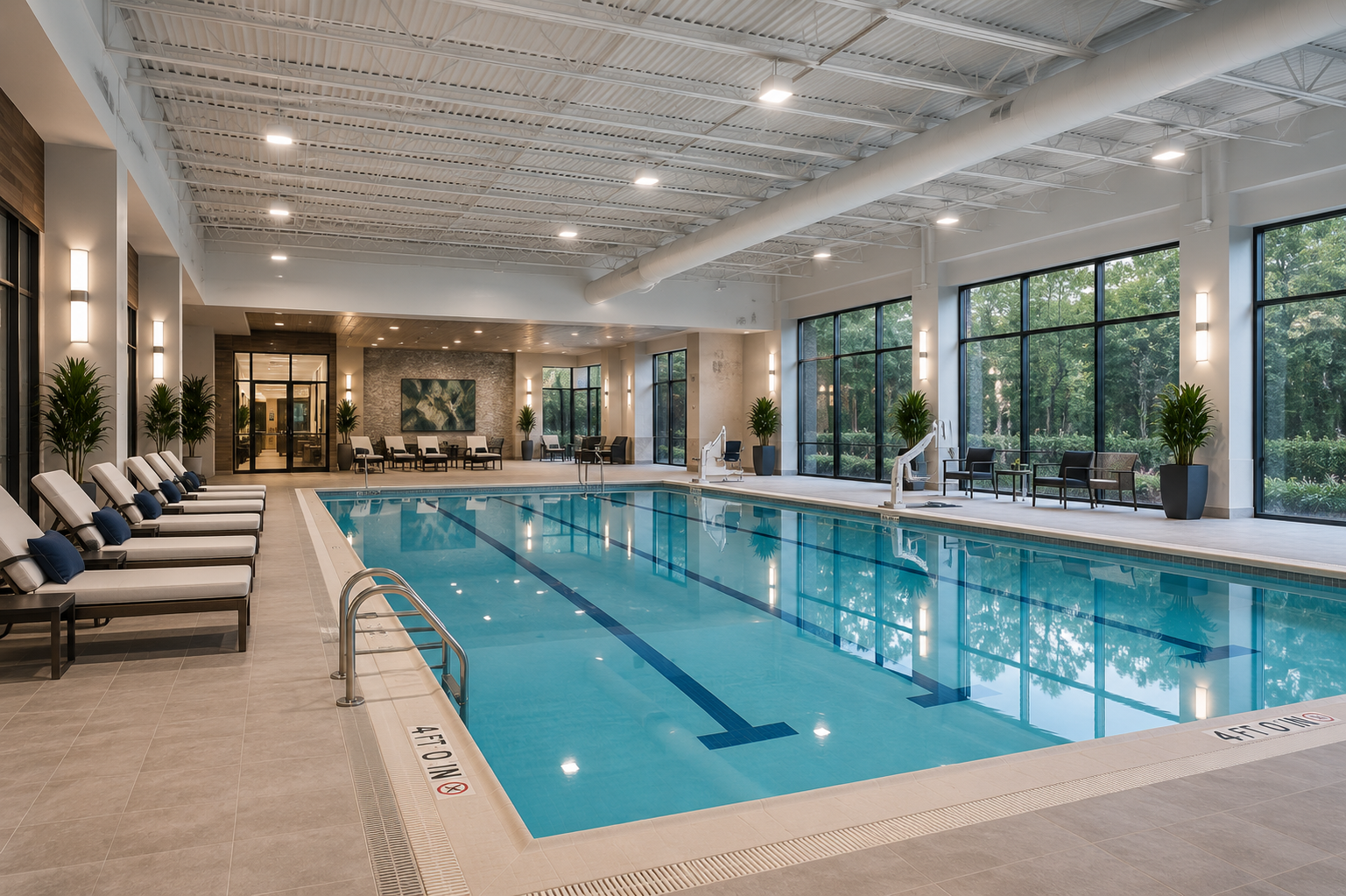
Custom Aquatic Lighting Built Around Your Pool, Your Space & Your Facility
No two indoor pools or natatoriums are exactly alike. Pool size and shape, ceiling height, structural obstructions, available mounting points, existing fixture locations, deck configuration, spectator areas and the surrounding architecture all influence how light should be delivered throughout the space.
LEDTOMORROW does not rely on a single lighting method. We evaluate each aquatic facility individually and develop the solution around the actual conditions of the space using the appropriate combination of indirect lighting, direct lighting and light engine replacements.
The Lighting Strategy Starts With the Pool — Not a Preselected Fixture
Indoor aquatic spaces are among the most demanding commercial lighting environments. Water reflections, elevated humidity, chemical exposure, unusual ceiling structures and limited maintenance access can all affect fixture selection, mounting and optical performance.
That is why LEDTOMORROW begins by understanding the complete facility. We look at where light can realistically be mounted, where obstructions may block distribution, how the water and deck are viewed from different positions, how high the ceiling is, and whether the existing fixture infrastructure can be reused. From there, we determine whether the best solution is direct, indirect, a light engine replacement, or a combination of all three.
Indirect, Direct & Light Engine Replacement Solutions
Each method solves a different set of challenges. The right approach depends on the dimensions, architecture, existing equipment and performance requirements of the facility.
Indirect Lighting
Indirect systems use ceilings, upper walls or other suitable architectural surfaces to reflect light into the aquatic space. This can soften the visual environment and reduce the prominence of bright point sources over reflective water.
Often considered when:
- Ceiling and wall surfaces can effectively receive and redistribute light
- Reflected glare is a major design concern
- High ceilings or competition environments require broad, uniform illumination
- A softer architectural appearance is desired
Direct Lighting
Direct lighting uses controlled optical distribution to place illumination where it is needed across pools, decks, walkways, entrances and other activity areas. It can be especially effective where ceiling height, structural geometry or available mounting locations make indirect illumination impractical.
Often considered when:
- Targeted light levels are required in specific zones
- Ceiling height is low to moderate
- Obstructions limit useful bounce surfaces
- Decks, lanes, circulation areas or entry points need controlled coverage
Light Engine Replacements
When an existing aquatic fixture housing is still structurally appropriate for the space, replacing the internal light engine and driver can provide a path to LED modernization without automatically replacing the entire architectural fixture.
Often considered when:
- Existing custom housings are difficult or costly to remove
- Current mounting locations are already well integrated into the facility
- The project needs to reduce disruption to ceilings, walls or surrounding construction
- LED performance and efficiency improvements are desired within compatible housings
What We Evaluate Before Recommending a Pool Lighting Solution
The performance of an aquatic lighting system depends on much more than fixture wattage. LEDTOMORROW evaluates the physical space first so the lighting strategy responds to the actual geometry and operating conditions of the facility.
Pool Size & Shape
Length, width, water geometry and deck configuration influence fixture quantity, aiming, spacing and the overall distribution strategy.
Ceiling Height & Room Volume
A low hotel pool and a large competition natatorium require fundamentally different approaches to output, distribution and mounting.
Structural & Space Obstructions
Roof trusses, HVAC ductwork, sound baffles, skylights, seating overhangs and other obstructions can block light or restrict viable fixture locations.
Available Mounting Points
We consider wall, ceiling, structural and existing fixture locations to determine how illumination can be delivered effectively without forcing an unsuitable layout.
Water Reflection & Viewing Angles
Swimmers, lifeguards, instructors and spectators view the water from different positions. Fixture orientation and distribution should account for reflected brightness across those sightlines.
Existing Fixtures & Infrastructure
For retrofit projects, we assess existing housings, locations and access conditions to determine whether full replacement or a light engine conversion is the better path.
Humidity, Chlorine & Corrosive Exposure
Aquatic fixtures operate in a demanding environment. Material selection, sealing, finish compatibility and maintenance access should reflect the conditions of the facility.
Facility Use & Performance Goals
Competition, instruction, recreation, hospitality and wellness spaces may require different levels of brightness, uniformity, glare control and scene flexibility.
Photometric Planning for Better Light Distribution
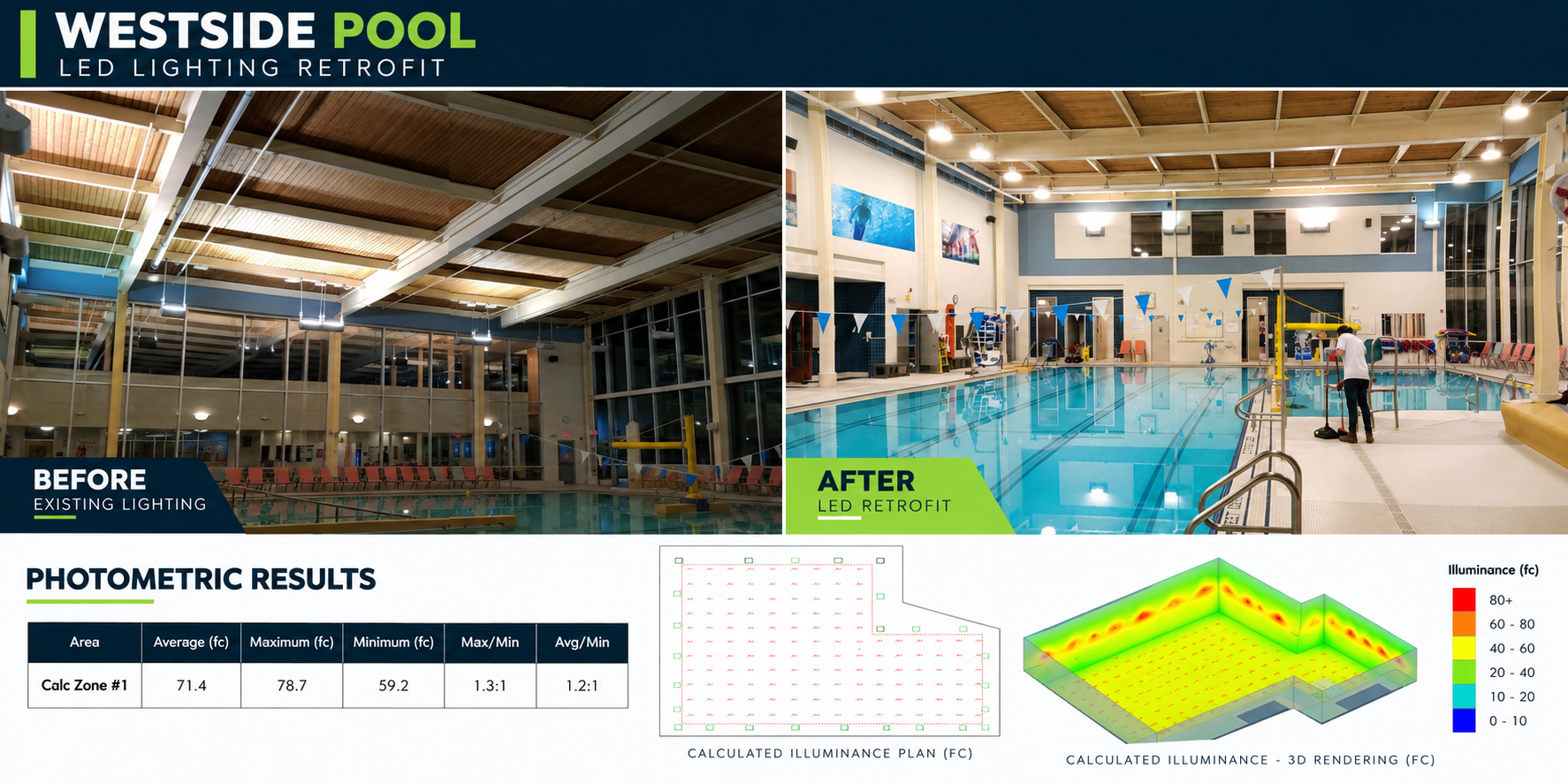
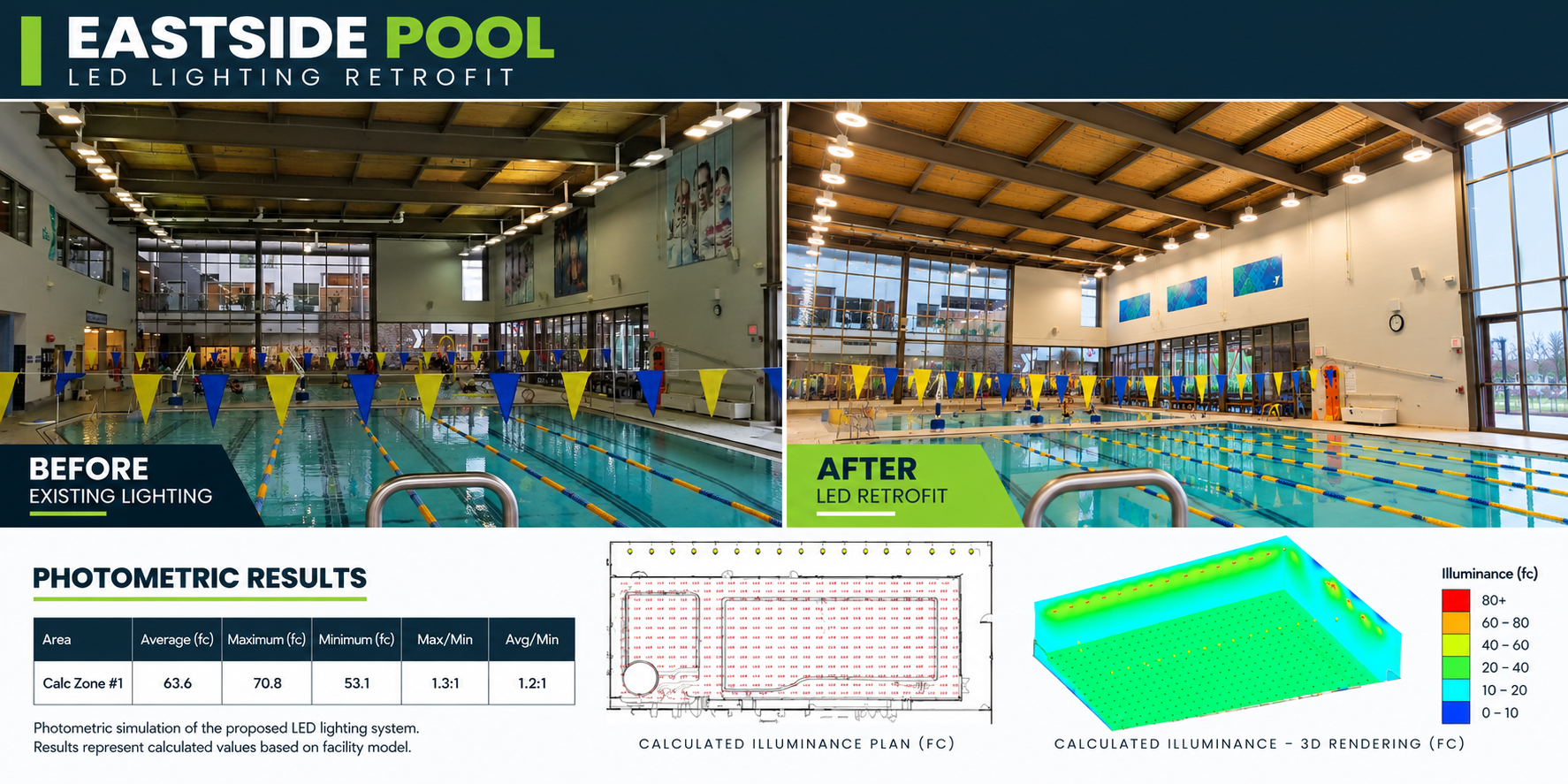
Photometric analysis can help evaluate how a proposed direct, indirect or combined lighting layout is expected to perform before installation. This is particularly useful in natatoriums where ceiling height, structural elements, water reflections and limited mounting positions make visual estimation difficult.
LEDTOMORROW can use the dimensions and operating requirements of the facility to help evaluate fixture quantity, placement, aiming, optical distribution and expected uniformity across the pool, deck and surrounding areas.
Photometric planning can help evaluate:
- ✓ Pool and deck illumination
- ✓ Direct and indirect fixture layouts
- ✓ Fixture spacing and mounting locations
- ✓ Lighting uniformity throughout the space
- ✓ Areas of excessive brightness or insufficient coverage
- ✓ Effects of structural obstructions
- ✓ High-ceiling natatorium applications
- ✓ Proposed retrofit layouts before installation
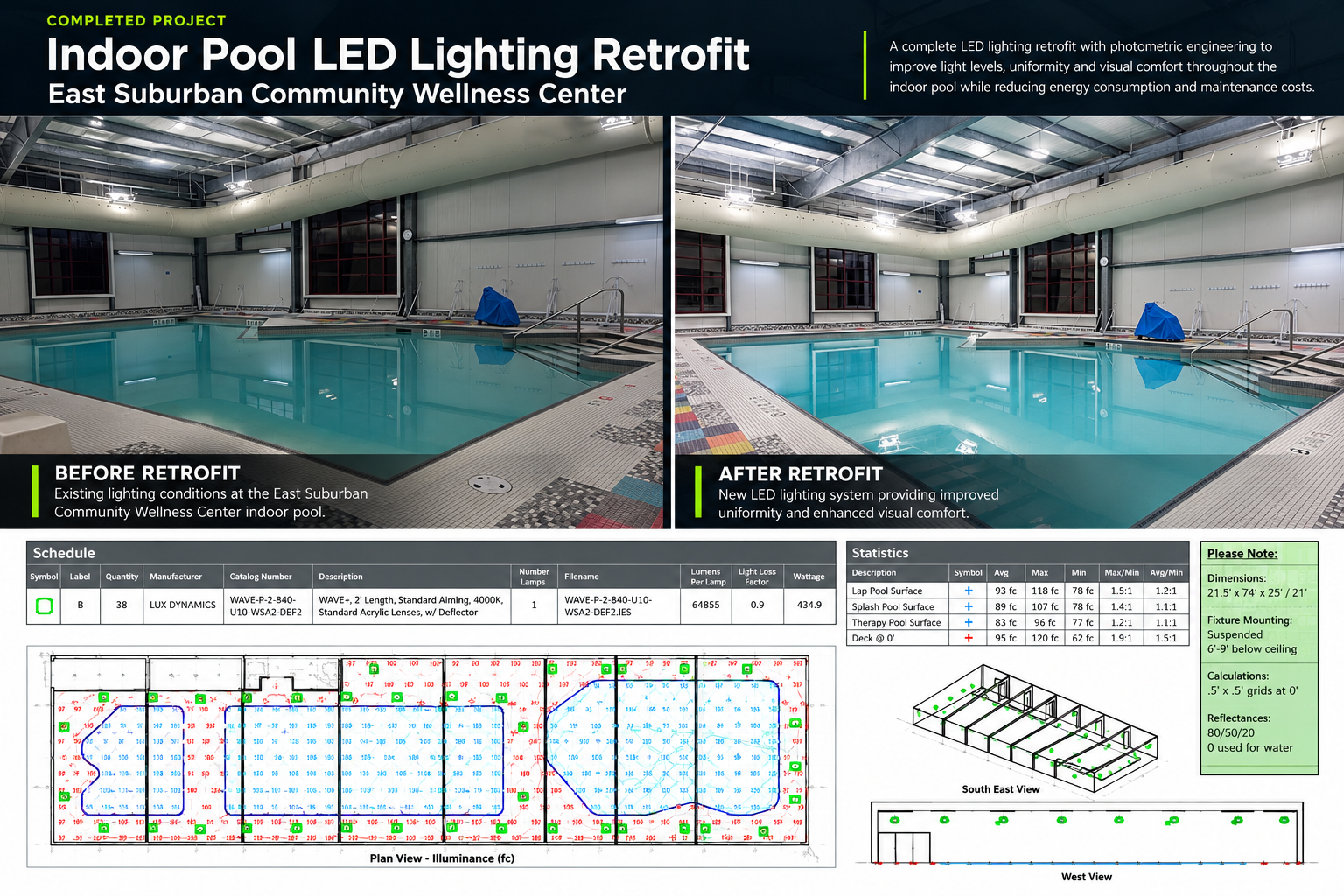
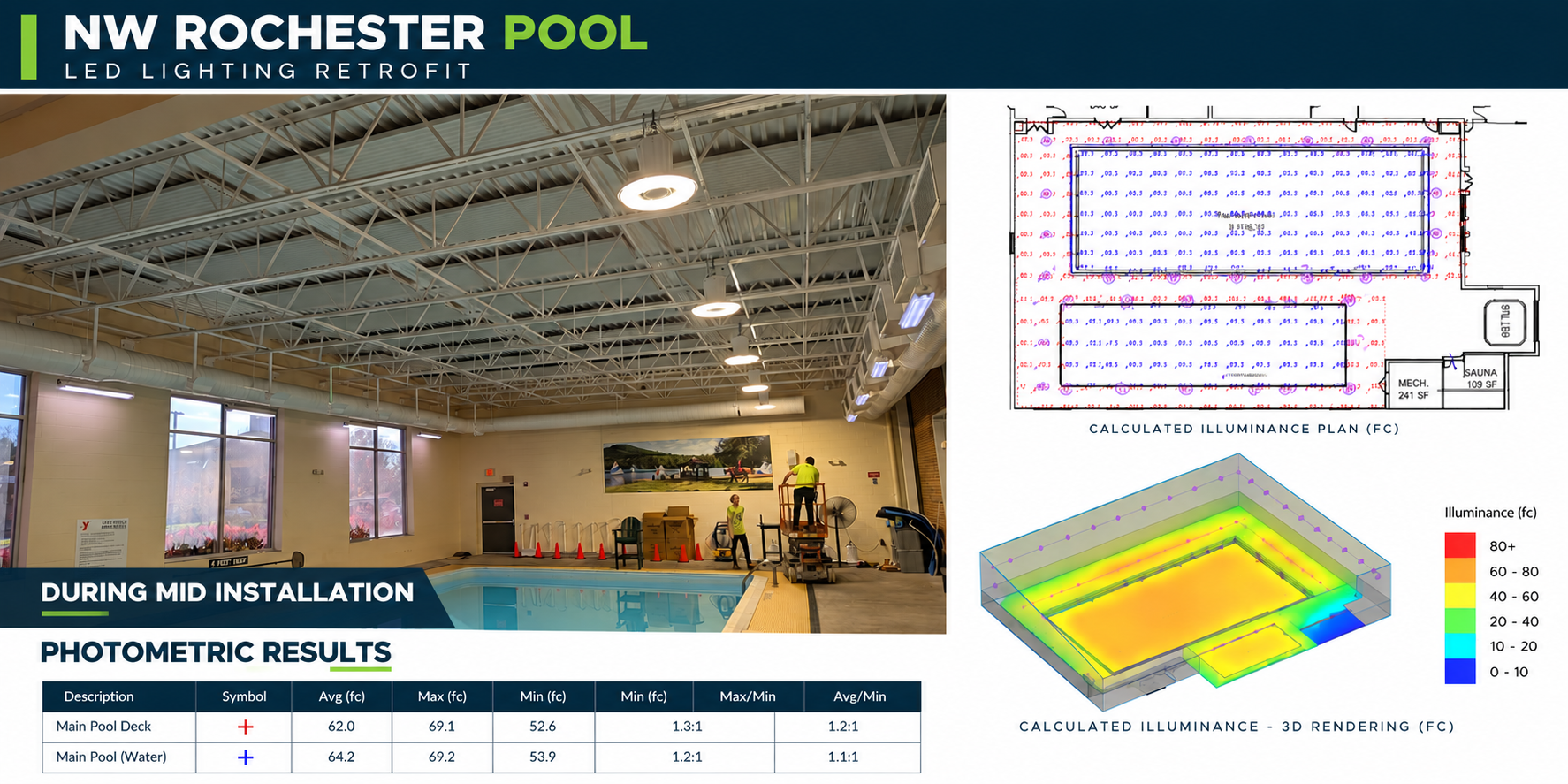
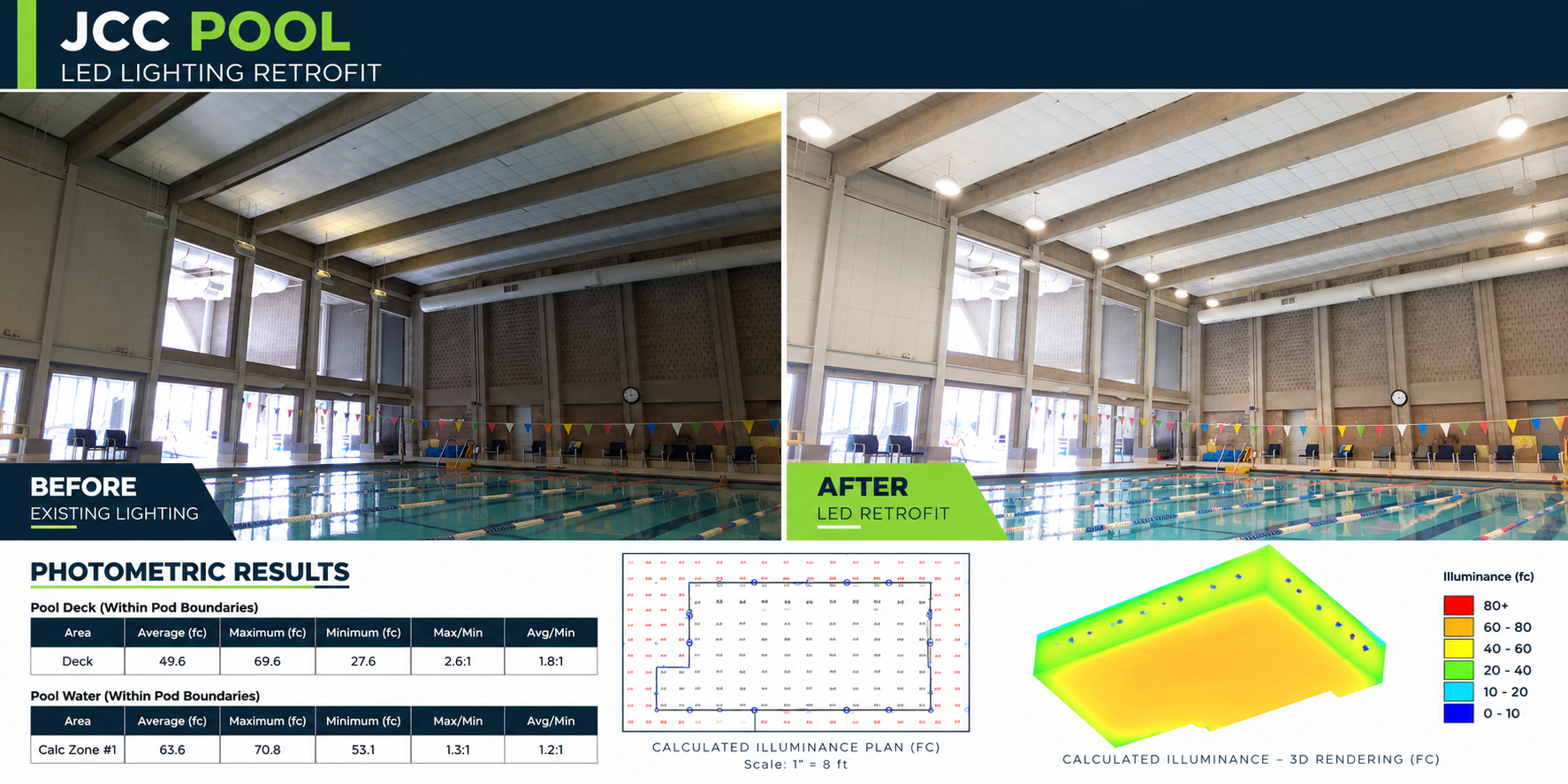
Additional Indoor Pool LED Retrofit Projects
Explore project photography, lighting retrofit comparisons and photometric design studies from additional aquatic facilities. Select an image to view the full-size project board.
Manage Reflections Without Limiting the Design to One Lighting Method
Water creates changing reflections that can make poorly planned lighting uncomfortable or difficult to view from certain positions. Managing that challenge does not automatically mean every facility should use indirect lighting.
Depending on the room, carefully aimed direct lighting, indirect illumination, layered systems or a combination of strategies may provide the better result. LEDTOMORROW considers fixture orientation, mounting height, viewing angles, optical distribution and brightness as part of the complete layout.
Modernize Existing Pool Fixtures With Light Engine Replacements
Many older natatoriums contain specialized housings that are integrated into walls, ceilings or difficult-to-access structural locations. Replacing every housing is not always the most practical first option.
Where existing housings are suitable and compatible, LEDTOMORROW can evaluate light engine replacement options that retain the fixture body while modernizing the internal LED source and driver. This approach can help reduce demolition and installation disruption while improving efficiency and lighting performance.
The Existing Fixture Matters
Light engine replacement is not a one-size-fits-all retrofit. Existing housing condition, dimensions, thermal management, mounting, electrical configuration and the environmental demands of the pool area should all be evaluated before determining whether reuse is appropriate.
Controlled Illumination Where the Facility Needs It
Direct aquatic lighting can be the right solution when the available mounting points, ceiling geometry or target areas call for controlled light delivered directly to the pool, deck or circulation space.
Rather than treating direct lighting as a compromise, LEDTOMORROW evaluates optical distribution, aiming and mounting location so the light supports the actual activity zones of the facility.
Direct lighting may support:
- ✓ Swimming lanes and activity areas
- ✓ Pool decks and perimeter circulation
- ✓ Steps, ladders and transition areas
- ✓ Entrances and access points
- ✓ Lower-ceiling aquatic spaces
- ✓ Facilities with limited reflective surfaces
- ✓ Spaces affected by ducts, trusses or other obstructions
Use Architectural Surfaces When the Space Supports It
Indirect lighting remains an important tool for aquatic facilities when ceilings or walls can be used effectively as part of the lighting system. It can create broad ambient illumination and help reduce the visual prominence of fixtures around highly reflective water surfaces.
The decision to use indirect lighting is based on the facility itself. Surface reflectance, ceiling height, available aiming locations, obstructions and required light levels all influence whether an indirect strategy is appropriate.
Indirect lighting may support:
- ✓ Broad, soft ambient illumination
- ✓ Reduced visibility of bright fixture sources
- ✓ High-ceiling natatoriums
- ✓ Competition facilities with complex sightlines
- ✓ Architectural pool environments
- ✓ Layered lighting strategies using both direct and indirect sources
Adapt the Pool Lighting to Different Activities and Times of Day
Indoor aquatic facilities can operate very differently throughout the day. Swim instruction, competition, recreation, cleaning, maintenance and hospitality use may each benefit from a different lighting condition.
LEDTOMORROW can help evaluate controls that allow direct, indirect and architectural lighting zones to respond to facility activity and available daylight.
Control strategies may include:
- ✓ Multiple lighting scenes
- ✓ Daylight-responsive control
- ✓ Dimming
- ✓ Scheduled operation
- ✓ Zone-based control
- ✓ Separate direct and indirect lighting control
- ✓ Event and after-hours settings
Custom Lighting for a Wide Range of Aquatic Facilities
The same three solution paths can be adapted to very different aquatic environments. The final design depends on how the facility is built and how it is used.
Competitive Natatoriums
Large aquatic facilities often require careful coordination of ceiling height, sightlines, deck coverage, water reflection and uniformity.
Schools & Universities
Educational pools may support training, competition, instruction and community use, making adaptable and maintainable lighting especially important.
Recreation Centers
Public aquatic spaces may need broad general coverage together with targeted deck and circulation lighting for varied daily activities.
Hotels & Resorts
Hospitality pools can combine functional direct lighting with indirect or architectural illumination to support both visibility and atmosphere.
Health Clubs & Fitness Facilities
Fitness-oriented aquatic spaces can use targeted lighting for instruction and exercise while maintaining comfortable conditions around surrounding wellness areas.
Spas & Wellness Properties
Wellness facilities may benefit from softer layered illumination while still maintaining practical lighting around decks, entrances and circulation paths.
How LEDTOMORROW Approaches Indoor Pool Lighting Projects
We do not force every pool into the same fixture layout. Our process starts with the facility and uses the available conditions to determine the right lighting method.
Evaluate the Facility
Document pool dimensions, ceiling height, obstructions, available mounting points, existing fixtures, water geometry and facility use.
Define Performance Priorities
Identify illumination, uniformity, glare, maintenance, retrofit, control and environmental requirements.
Select the Right Strategy
Determine whether direct lighting, indirect lighting, light engine replacement or a combined system best fits the pool.
Verify & Support
Use layout and photometric evaluation where appropriate, then support the project through product selection and implementation.
Indoor Pool Lighting Questions
Does LEDTOMORROW only use indirect lighting for pools?
No. LEDTOMORROW works with indirect lighting, direct lighting and light engine replacements. The recommended approach depends on the size and shape of the pool, ceiling height, structural obstructions, available mounting locations, existing equipment and required light distribution.
When is direct lighting appropriate for an indoor pool?
Direct lighting may be appropriate where controlled illumination is needed over specific activity areas, where ceiling height is lower, or where the architecture does not provide suitable surfaces for an indirect system.
When is indirect lighting appropriate?
Indirect lighting can be effective when ceilings or upper walls provide useful reflective surfaces and the project would benefit from broad ambient illumination or reduced visual prominence of bright fixture sources.
Can existing aquatic fixtures be converted to LED?
In some facilities, yes. LEDTOMORROW can evaluate existing fixture housings to determine whether a compatible light engine and driver replacement is an appropriate alternative to complete fixture replacement.
Why are pool dimensions and ceiling height important?
Room geometry determines how far light must travel, how fixtures can be spaced, where they can be mounted and how effectively light can reach the water, deck and surrounding areas.
Can photometric layouts be created for indoor pools?
Yes. Photometric planning can help evaluate expected illumination, uniformity, fixture placement and coverage before installation, particularly in large or architecturally complex aquatic facilities.
How does LEDTOMORROW account for obstructions?
Structural beams, HVAC ductwork, roof trusses, sound baffles, seating and other building elements are considered when evaluating fixture location, aiming and distribution so the lighting strategy reflects the actual space rather than an idealized room.
Let Us Evaluate Your Indoor Pool Lighting Project
Whether the right solution is indirect lighting, direct lighting, a custom light engine replacement or a combination of strategies, LEDTOMORROW starts with the actual pool environment. Send us the facility dimensions, ceiling height, available mounting locations, existing fixture information and project goals, and we can help evaluate the next step.